Avram Grant Part 3: Forging the Future. Tips for Aspiring Coaches

TL;DR
- Cultivate Relentless Curiosity: Never run a drill without understanding its core purpose – always ask how and why.
- Invest in Your Own Education: Seek out the best coaches to observe and learn from, even when it costs you personally.
- Prepare for Individualized Coaching: The future of football is highly specialized – head coaches will oversee armies of positional experts.
- Balance Philosophy with Results: Senior football gives you four months, not four years. Your tactical ideals must be built to win.
- Build a Club, Not a Team: Invest in youth, methodology, and long-term infrastructure – not just next season’s signings.
- Pressure is a Privilege: The stress before a match is not a burden to manage – it is the engine that drives achievement.
In the final part of our series on Avram Grant’s journey, we look at what aspiring coaches can do to build a career in the modern game.
Grant started his coaching career almost by accident at the age of 18 with the youth teams of Hapoel Petah Tikva. He climbed the ranks to eventually manage Chelsea in the UEFA Champions League Final, as well as several national teams. During our conversation session with Nir Levin, Grant shared invaluable insights specifically tailored for the next generation of managers.
Today, while club management platforms provide the digital backbone to organize operations, the core traits of a successful coach remain profoundly human. Here are Avram Grant’s top lessons for youth and aspiring coaches looking to forge a successful path in the modern game.
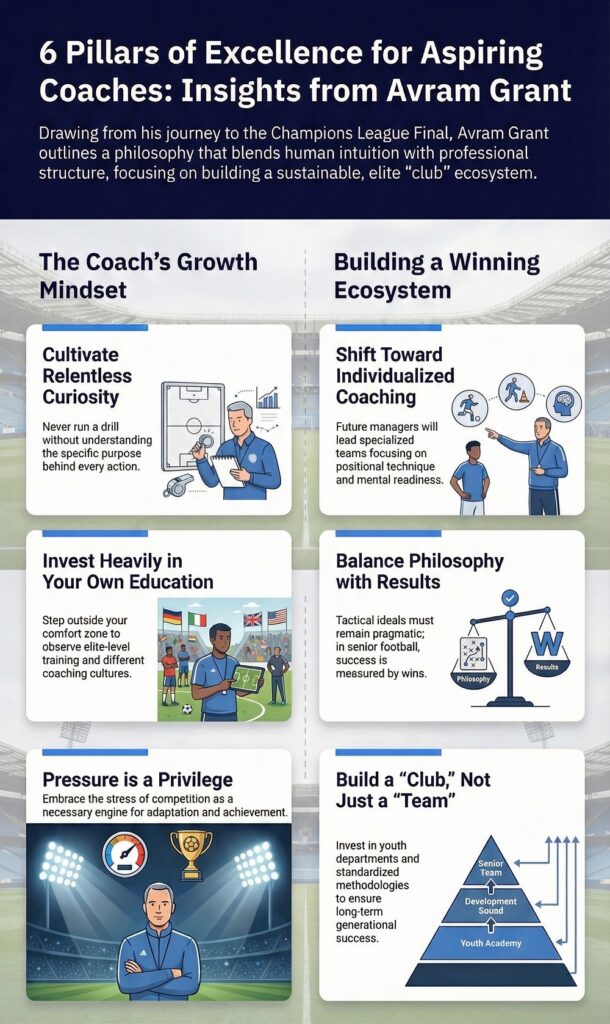
1. Cultivate Relentless Curiosity
If there is a single trait that defined Grant’s early career, it is an insatiable curiosity. When he first started coaching, he enrolled in a physical education program at the Kibbutzim College simply to better understand the mechanics of his players. He constantly asked “how” and “why” things were done, driven by a deep desire to understand the purpose behind every action on the pitch.
Grant recalled attending a coaching seminar led by a veteran manager early in his career. When the senior coach demonstrated a drill, Grant raised his hand and asked, “What is the purpose of this drill?” The older coach, offended by the questioning from a young upstart, replied, “Young man, did you come here to confuse me?”. For Grant, this highlighted a fundamental flaw. You must never run a drill just for the sake of it. Aspiring coaches must maintain relentless curiosity, constantly questioning their own methods and seeking the core objective behind every tactical decision.
2. Invest Heavily in Your Own Education
Long before the era of the internet and digital video scouting, Grant understood that to be the best, he had to observe the best. As a young coach, he used his own money to travel across Europe and watch top-tier teams train.
He famously travelled to Italy to observe Sampdoria, studying the methods of legends like Roberto Mancini and Fabio Capello. Grant even recalled jumping over a fence just to get a glimpse of Capello’s training sessions. The investment paid off beautifully. Years later, after Capello was appointed manager of the England National Team, the legendary Italian manager actually approached Grant, sitting with him for hours to learn the specific differences between managing a club and a national team. Today, education is far more accessible, but the internal drive to seek it out remains a non-negotiable requirement for success.
3. Prepare for the Era of Individualized Coaching
When asked where the future of football is heading, Grant was unequivocal: the game is becoming increasingly physical, which means players will have drastically less time to think. To survive, players must possess the ability to execute high-level technique under immense physical pressure.
Grant predicts a massive shift toward highly individualized coaching. He foresees a future where a head coach acts more like a general manager, overseeing an army of highly specialized positional coaches, including dedicated staff whose sole focus is keeping substitute players mentally sharp and ready the moment they step onto the pitch. Grant pointed to Johan Cruyff as a pioneer, noting that Cruyff utilized a specialized coach at Ajax whose entire role was teaching players how to deliver the perfect cross. Aspiring coaches should consider developing a highly specialized skill set and learning how to coordinate these micro-level, individualized training plans across an entire squad.
4. Balance Your Philosophy with Immediate Results
Aspiring coaches are often eager to implement grand tactical philosophies, but Grant warns that modern football rarely affords you the luxury of time. He shared a revealing conversation with Clarence Seedorf, who was transitioning into management and believed he needed at least a year to instill his footballing philosophy at a new club.
Grant bluntly corrected him: “You have four months. You start, you have a month of preparation, and if the results aren’t good after three months, you’re in trouble… you can want a year, or six! it doesn’t matter”. While youth development allows for patience, senior football is unforgiving. A coach’s philosophy must be geared towards winning. As Grant notes, he does not teach players to play “beautiful football” just for the sake of aesthetics; he teaches good football because good football wins matches.
5. Build a “Club”, Not Just a “Team”
When transitioning into management or stepping into a technical director role, there is a temptation to chase immediate, short-term fixes. Grant learned a profound lesson on this topic during his time managing Hapoel Haifa, courtesy of the club’s late owner, Robi Shapira.
Grant presented Shapira with a list of four high-profile players he wanted to sign. He promised, “Bring me these four signings, and I will build you a great team”. Shapira’s response completely shifted Grant’s perspective: “I don’t want to build a team. I want to build a club. There are many teams, but there are not many clubs”. Shapira proceeded to invest heavily in the youth department, establishing a foundation that would last for generations. For modern directors and coaches, this is the ultimate goal: utilizing a comprehensive club management plan to align your youth academy, standardize your coaching methodology, and establish long-term educational pathways.
6. Pressure is a Privilege, Not a Penalty
Finally, Grant addressed the concept of pressure, both tactical pressing on the pitch and the immense psychological pressure off it. Many players and coaches complain about the stress before a big match. Grant’s response is simple: embrace it.
“If you aren’t under pressure before a game, how will you achieve anything?” he asks. Coming into a match completely relaxed without any pressure doesn’t show strength; it shows a lack of caring. Pressure is the necessary engine that constantly pushes individuals to adapt, overcome, and achieve greatness.
The Digital Backbone for Your Journey
For aspiring coaches, mastering the tactical and psychological elements of the game takes a lifetime of dedication. To free up your time to focus on these crucial human elements, you need reliable infrastructure. EasyCoach serves as the digital backbone for sports organizations, centralizing operations, communication, and performance data into one unified platform. By combining your relentless curiosity with professional-grade tools, you can bring an elite standard to every team you manage.
Frequently Asked Questions
What is Avram Grant’s most important piece of advice for aspiring coaches?
Stay curious. Grant’s entire career was built on asking why, not just following convention. He believes coaches who stop questioning their own methods stop growing.
How did Avram Grant approach his own coaching education early in his career?He paid out of his own pocket to travel across Europe and watch top clubs train. He studied under coaches like Fabio Capello and Roberto Mancini long before video libraries and digital scouting existed. The drive to seek out that education was self-directed, not institutionalized.
What does Avram Grant predict about the future of coaching?He sees the game moving toward highly individualized coaching. Head coaches will function more like general managers, overseeing specialized coaches for specific positions and roles, including dedicated staff for substitute players.
How much time does a coach realistically have to implement their philosophy at a new club?Grant puts it plainly: about four months. One month of preparation, and if results are not there after three, the pressure builds fast. Philosophy has to be built to win, not just to express an idea.
What is the difference between building a team and building a club?Grant learned this distinction from club owner Robi Shapira at Hapoel Haifa. A team wins games this season. A club invests in youth, methodology, and long-term infrastructure. Most organizations aim for the former. The best ones commit to the latter.
How should coaches think about pre-match pressure?Grant reframes it entirely. Pressure before a match is not a problem to solve. It is proof that you care. Walking in relaxed without any edge is not composure. It is indifference.
How does EasyCoach support the kind of coaching Grant describes?The platform gives clubs the operational backbone to free coaches from admin and focus on the craft. Scheduling, session planning, player tracking, and communication run through one system, so coaches spend less time managing and more time developing players.
Run it like the pros.
The platform Villarreal CF runs on.
See EasyCoach on your club or your federation. Book a 20-minute demo with our team.

Modern Trends for Set-Piece Success
Modern Trends, Edge-of-the-Box Exploitation, and Effective Coaching Strategies

Marko Krnjić: 5 Key Insights for the Modern Football Coach
Lessons from a Career in Elite Performance

The Skill of Being Yourself: A Guide to Human-Centric Coaching
Practical Lessons on Mentorship, Practice Design, and Fostering Belonging