


From Youth Academies to Elite Ecosystems:
Experience and Expertise
Part Two of a three-part series based on a masterclass session with former Chelsea coach Avram Grant hosted by Nir Levin.
⚡ TLDR — Quick Summary
- Youth vs. Senior Objectives: Youth development focuses on individual progression, while elite senior football is ruthlessly results-driven.
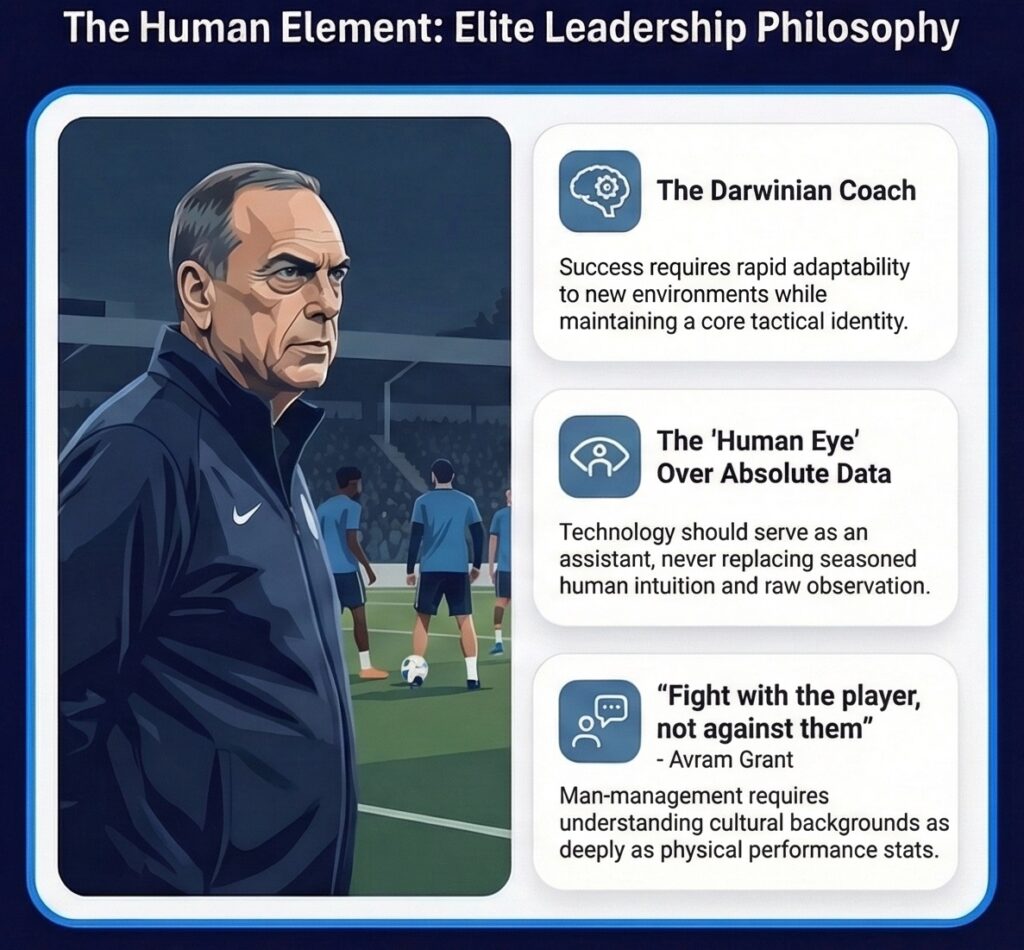
- The Darwinian Coach: Survival in global football requires rapid adaptability to new cultures and environments without losing your core identity.
- Data + The “Human Eye”: Technology must empower- not replace – seasoned human intuition.
- Leading Through Crisis: True leadership means acting as a psychological shield for players during organizational chaos, turning adversity into team unity.
- Universal Man-Management: Tactics are universal, but people are not. Understanding a player’s cultural background is just as vital as understanding their physical stats..
In the second part of our series on Avram Grant’s masterclass, we shift our focus from his psychological philosophy to his tangible experience and expertise.
Having managed across England, Africa, Israel, and beyond, Grant’s career is a masterclass in adaptability, the evolution of data, and the distinct differences between youth development and elite senior football. For technical directors and administrators relying on comprehensive club management, Grant’s historical perspective provides a roadmap for sustainable organizational success.
The Duality of Football
Youth Development vs. Senior Results Grant began his coaching journey incredibly early, taking charge of youth teams at just 18 years old. He spent years mastering the art of player development before transitioning to senior football management around the age of 30. He stresses that while the sport looks the same, the objectives of youth and senior football are fundamentally different.
In a youth academy, the primary goal is to produce and prepare players for the senior squad. While winning is important for instilling a competitive mindset, it is secondary to individual player progression. However, in senior football, the reality is very different. As Grant bluntly states, “You are as good as your last result”. In elite club environments, the primary objective is securing points and winning matches, making youth integration a secondary (though still vital) goal for the club executives.
Adaptability: The Darwinian Coach
Throughout his global career, which recently included managing the Zambia national team, Grant has lived by a famous quote attributed to Charles Darwin: “It is not the strongest that survives, nor the most intelligent, but the one most responsive to change”. Whenever Grant joins a new club or federation, his goal is to bring his core philosophy while rapidly adapting to the local culture, environment, and challenges, ensuring he never loses his own unique identity in the process.
The Evolution of Analytics and the “Human Eye”
Today, any club management platform and coaching system is heavily driven by data, analytics, and video tracking. Grant was a pioneer in this space long before the digital age. As early as 1988, he hired university students to manually track player statistics like ball recoveries and turnovers. He even hired a local wedding photographer to film matches so his players could review their positioning – a rarity at the time.
Despite being an early adopter, Grant offers a strong warning to modern coaches who treat data as “Torah from Sinai” (absolute gospel). He believes technology must strictly serve as an assistant to the coach, never a replacement. He illustrated this with a story from his time as a technical director at Chelsea. He employed an 80-year-old scout with an incredible “eye” for talent. Grant explicitly forbade the scout from looking at player data, relying entirely on the man’s raw, experienced human observation to determine if a player fit the club’s philosophy. The ultimate formula, according to Grant, is the seamless integration of advanced data with seasoned human intuition.
Crisis Management and Leadership
Under Fire Beyond data and youth integration, Grant’s career offers a masterclass in crisis management. His tenure at Portsmouth during the 2009-2010 season remains a prime example of his leadership philosophy in action. The club was thrust into administration, hit with a severe points deduction, and forced to sell key players due to financial ruin.
Instead of abandoning ship, Grant used the adversity to unify the dressing room, miraculously guiding the relegated side to an FA Cup final. He teaches that during times of deep organizational chaos, a manager must act as a psychological shield for the players. For modern technical directors, this highlights a crucial lesson: while club management platforms can organize operations, it is resilient, empathetic leadership that holds a club together when structural foundations shake.
The Universal Language of Man-Management
Grant’s journey from Israeli domestic leagues to the dugout at Stamford Bridge, and eventually to the national teams of Ghana and Zambia, required a profound understanding of cultural nuances. He emphasizes that while football tactics are universal, human beings are not.
Managing the pressure and ego of a Champions League veteran demands an entirely different approach than inspiring a young talent in an emerging federation. Grant operates by a simple rule: fight with the player, not against them. Discipline should be a cost-benefit tool rather than a moral stance, and understanding a player’s cultural and personal background is just as vital as understanding their heat map on the pitch.
Conclusion: Empowering the Modern Club
Avram Grant’s decades of experience prove that success in football is not achieved by choosing between old-school intuition and new-age technology- it is about harmonizing them. Club management platforms like EasyCoach are designed to provide the robust structural, analytical, and administrative support that modern clubs need to thrive. But as Grant reminds us, these tools are only as effective as the human beings wielding them. By combining cutting-edge data with Darwinian adaptability, a keen “human eye,” and elite man-management, clubs can build a sustainable, winning ecosystem from the youth academy all the way to the senior squad.
In Part 3, Avram shares a series of practical tips for youth coaches and development teams.
Frequently Asked Questions
Grant borrows from Charles Darwin’s philosophy, stating that the most successful coaches aren’t necessarily the smartest or strongest, but the ones most adaptable to change. Whether moving to a new country or facing modern tactical shifts, a coach must quickly adapt to their environment while maintaining their core philosophy.
Not at all. In fact, he was a pioneer of manual data tracking and video analysis in the 1980s. However, he warns against treating data as absolute gospel. He believes platforms and analytics are essential assistants to the coach, but they must always be paired with raw, experienced human observation—the “human eye.”
Grant emphasizes that academy directors must separate the pressure of winning from the goal of development. While cultivating a winning mentality is healthy, the ultimate metric of success in a youth academy is how well it prepares individual players for the senior squad, not the trophy cabinet.
Grant treats discipline as a practical tool, not a moral principle. He applies a cost-benefit lens: a disruptive player who scores 18 goals is not worth the trouble, but one who scores 30 might be. His broader philosophy is to fight with players to extract their best, not against them. He estimates athletes are driven 80% by the desire to succeed and 20% by fear of failure.
Ready to Put Analytics Into Practice?
EasyCoach brings all your player data, session planning, communication, and medical tracking into one platform — so you can coach smarter, not harder.