Inside the Evolving World of the Modern Football Scout

TL;DR
This article details how modern football clubs systematically manage recruitment by balancing squad structures and navigating complex post-Brexit regulations. It explores the debate between data-led and data-informed processes, demonstrating how clubs utilise customised AI platforms to align with their playing philosophies, verify metrics, challenge scouting results, and improve time efficiency.
In the contemporary game, the image of the solitary figure in a rain-slicked trench coat, clutching a tattered notebook at a damp non-league ground, is rapidly fading into obsolescence. In its place has emerged a high-stakes, multi-disciplinary profession where a single signing can dictate a club’s financial solvency and competitive legacy for a decade. Today’s scouting is an intricate dance of data models, AI-customised platforms, and rigorous technical methodology. The modern scout acts as a strategic architect, building a squad with the precision of a master builder.
A leading figure in this professional evolution is Ben Valentine. Currently a vital component of the recruitment operation at Luton Town, Valentine recently pulled back the curtain on the inner workings of his craft during ‘The Modern Scout’ webinar, hosted by Football Webinars. His career serves as a quintessential case study in how the profession has shifted from the touchline to the data room, moving from the intuition-led era of the past to a future defined by global regulatory navigation.
Valentine’s Professional Journey
A scout’s “eye” is rarely a birthright, it is a developed faculty, honed through years of observation and the influence of seasoned mentors. A scout’s history dictates their biases and their strengths, making the journey from the dugout to the stand a vital period of maturation. Valentine’s career trajectory illustrates the necessity of diverse experience in forming a complete recruitment philosophy.
Beginning his formal journey into scouting at Chester FC in 2014, Valentine moved through the ranks at Eastleigh and Torquay United before finding a long-term professional home at Luton Town in April 2016. His versatility is further evidenced by a two-year tenure as a Goalkeeper Coach for the Luton Women’s Team, reflecting a holistic understanding of every positional requirement on the pitch.
This professional maturation was steered by what Valentine terms “Major Career Influences.” Under the tutelage of Steve Burr at Chester, and subsequently at Luton with Mick Harford, club ambassador, and Phil Chapple, the former head of scouting operation, Valentine learned to bridge the gap between traditional footballing wisdom and modern operations. These figures were instrumental in teaching him that while the “eye test” remains the soul of the profession, it must be supported by a rigorous, repeatable technical methodology to survive the scrutiny of the modern boardroom.
Mastering Team and Player Assessments
In a sport as subjective as football, a structured methodology is the only safeguard against cognitive bias. Valentine’s approach to “Team Assessments” begins with meticulous preparation before a ball is even kicked. This involves “Segmentation” and the study of “Lineages” – monitoring previous lineups and injury lists to understand how managerial changes or squad availability might alter the structural “shape” of an opponent.
Once the match begins, observation is filtered through the “Four Phases of Play,” a technical framework designed to capture the total essence of a team’s tactical identity:
- Offensive Transition: How a team reacts at the moment they regain the ball – do they counter-attack with verticality or look to reset possession?
- Defensive Transition: The structural reaction at the moment of turnover, specifically the speed and discipline of the “counter-press” or the retreat into a mid-block.
- Defensive Shape: The structural integrity, spacing, and discipline of the unit when out of possession.
- Offensive Build-up: Established patterns of play, attacking intent, and how a team progresses the ball through the thirds.
This analysis is rounded out by an assessment of Set Pieces and “Individual Player Traits,” where a player’s strengths and weaknesses are mapped against their specific role. This structured “eye test” provides the qualitative foundation, which is then cross-referenced against the digital frontier to ensure the scout’s vision aligns with statistical reality.
Data-Led vs. Data-Informed
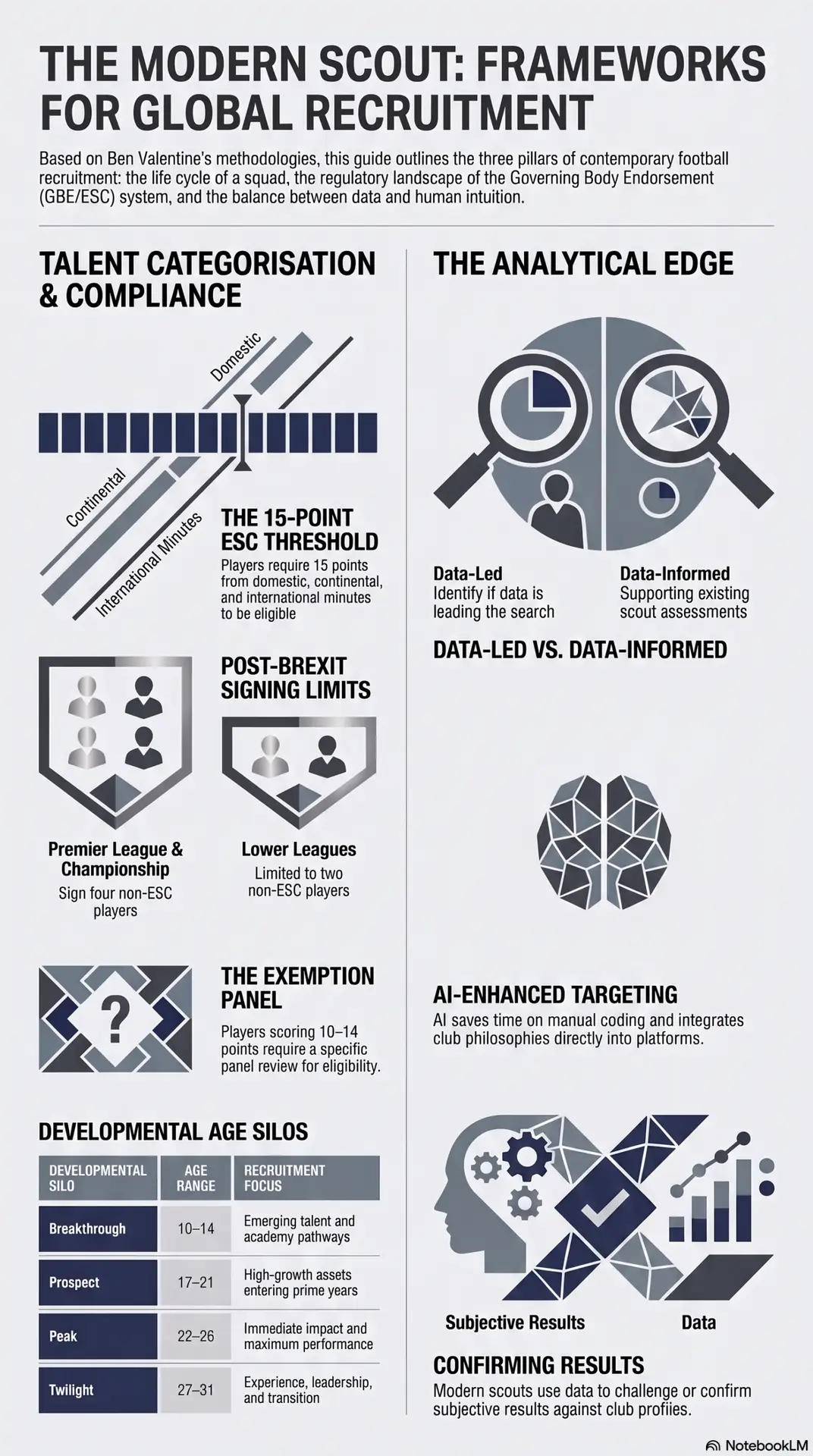
The modern recruitment landscape is defined by the tension between human observation and algorithmic prediction. Valentine distinguishes between “Data-Led” (where algorithms identify targets) and “Data-Informed” (where data supports a scout’s existing observation). The introduction of AI has fundamentally shifted this dynamic, allowing clubs to customise platforms to match their specific playing philosophy.
However, the modern scout must also act as a quality control auditor. Part of the role is now “Testing Accuracy” – verifying the data quality provided by third-party platforms to ensure it reflects the reality of the pitch. This bespoke approach allows for:
- Faster Targeting: Enabling scouts to bypass manual coding and focus on players who fit the specific club profile.
- Confirmation or Challenge: Using data to either confirm or challenge a scout’s initial results.
- Level Suitability: Assessing whether a player’s statistical output in a lower “Band” league is likely to translate to the intensity of the Premier League or Championship.
Ultimately, data serves as a filter that focuses the scout’s attention, but it must still be reconciled with the physical reality of the squad’s long-term structure.
Squad Equilibrium
Effective recruitment is about maintaining “Squad Balance.” Valentine utilises “Age Silos” to ensure a club avoids a “performance cliff” where too many players decline simultaneously, or a financial trap where there is no resale value in the squad.
| Silo | Age Range | Strategic Focus |
|---|---|---|
| Breakthrough | 17–21 | Future potential, high resale value and developmental upside. |
| Prospect | 22–26 | Entering their prime, the functional “engine room” of the squad. |
| Peak | 27–31 | Proven performers providing immediate stability and leadership. |
| Twilight | 32+ | Experienced veterans, requires careful succession planning. |
At Luton Town, this balance is visible in a squad containing “Breakthrough” talents like 18-year-old Chigozie, “Prospects” like Teden Mengi (24), and “Twilight” leaders like James Shea (36). Contrast this with Chelsea’s heavy lean into the “Breakthrough” and “Prospect” categories with Estevão (19) and Cole Palmer (24), or Arsenal’s commitment to a “Peak” core featuring Declan Rice (27) and Martin Ødegaard (27).
Further complicating this is the post-Brexit regulatory landscape. To sign non-domestic talent, players must be “ESC Eligible,” achieving a 15-point threshold under the Governing Body Endorsement (GBE) and Elite Player Performance Plan (EPPP) criteria. These points are calculated based on domestic, continental, and international minutes. Leagues are divided into “Bands,” with Band 1 (e.g., Premier League, La Liga) offering the highest point yields. Current regulations limit Premier League and Championship clubs to four “non-ESC” signings (players who fall short of the 15 points but are granted an exemption), while League 1 and 2 are restricted to two. This has forced scouts to find value in untapped regions to secure eligible talent within these strict quotas.
The Future of the Eye in the Sky
The role of the football scout has undergone a profound metamorphosis. It is no longer a profession of mere observation, but one of rigorous methodology, regulatory mastery, and technological fluency. Despite the influx of AI, the “Modern Scout” remains the essential human element – the auditor who verifies the algorithm and the architect who navigates the complexities of squad equilibrium. As Ben Valentine’s journey demonstrates, the scout is no longer just a talent spotter, they are a strategic visionary, ensuring that the players signed today are the foundations upon which tomorrow’s trophies are built.
FAQ
This is where the distinction between being data-led and data-informed becomes critical. If a club blindly follows standard off-the-shelf algorithms, they will inevitably target the exact same players as their competitors. The key to maintaining a unique competitive edge is customisation. By tailoring AI platforms to track metrics specific to a club’s distinct playing philosophy, such as a precise counter-pressing trigger radius or very specific offensive transition patterns, scouts can uncover undervalued profiles that other data models completely overlook. Data filters the noise, but the club’s unique blueprint dictates what is considered valuable.
The introduction of the 15-point GBE threshold and strict non-ESC quotas has forced recruitment operations to become much more creative and geographically agile. Instead of focusing heavily on traditional, highly-scouted European markets where prices are inflated, scouts are shifting their gaze to untapped regions, such as emerging leagues in Asia, South America, or lower-tier Scandinavian divisions where players might still meet eligibility criteria or qualify for limited exemptions. It has turned scouting into a race for regulatory efficiency, where understanding work-permit math is just as important as identifying technical talent.
While anyone can access global match footage or download statistical Radars from their bedroom, the differentiator remains context and human verification. An elite scout doesn’t just look at what a player did; they analyze why they did it within the context of their team’s tactical instruction, the pitch conditions, and their psychological resilience under pressure. Furthermore, professional scouting requires acting as a quality control auditor, physically verifying that the statistical output provided by data platforms matches the reality of the player’s live performance. Technology democratizes the data, but human intuition and rigorous live methodology still secure the signing.
The primary value of an all-in-one platform like EasyCoach is that it eliminates fragmented workflows by providing a single “Source of Truth”. Traditionally, scouting departments operate in isolation, scattering player evaluations, shortlists, and recruitment data across personal spreadsheets, external video platforms, and messaging apps. An integrated system brings scouting directly into the same data foundation as administration, medical, and performance analytics. For a recruitment department as youth scouting figures at clubs like Villarreal CF have noted this drastically improves organization by allowing scouts to seamlessly track targets, log deep evaluation reports, build structured shortlists, and align strategic sporting decisions directly with the club’s long-term tactical blueprint. It ensures that the moment a target is identified, the technical director, coaching staff, and data analysts are all instantly looking at the exact same player history and performance metrics.
Run it like the pros.
The platform Villarreal CF runs on.
See EasyCoach on your club or your federation. Book a 20-minute demo with our team.

The Hidden Language of Player Behaviour
Why modern coaching demands a trauma-informed lens.

Long-Term Athlete Development: What Every Academy Should Know
What LTAD actually asks of an academy, stage by stage, and where most clubs get it wrong.

Using Data to Make Better Decisions About Player Development
Coaching intuition still matters. Here is where data sharpens it rather than replaces it.