The Inner Game: Fear, Authenticity, and Who You Really Are on the Touchline
TL;DR
- Modern coach education ignores the emotional life of the coach entirely.
- Authenticity is the most effective thing a coach can transmit to a group.
- Unconscious fear, driven by “what if,” restricts players and limits coaches.
- Vulnerability is not a weakness. It is the condition for growth.
- When operations run themselves, coaches can focus on what actually moves people..
Louis Harrington has spent over a decade working with professional athletes and corporate leaders on human performance. Not tactics. Not systems. The person behind the role.
In a recent session hosted by EasyCoach, he made an argument most coaching courses never touch: the environment your team creates on the pitch is a direct reflection of what is happening inside you.
The Gap in Every Coaching Badge
Think about your last coaching certification. Tactical systems. Formation shifts. Player development models.
How much time was spent on the human being doing the coaching?
According to Harrington, the answer is almost always zero.
Emotion Is Energy
Football people talk about energy constantly. A team lacked energy in the first half. A sub changed the energy of the game.
But coaches rarely examine their own.
Harrington’s starting point: emotion equals energy in motion. If you are flat, your players know. If you are anxious, your players carry it. The state you are in does not stay with you. It moves through the room.
The most effective thing a coach can transmit is not confidence or intensity. It is authenticity. That happens when what you say and what you believe are the same thing.
Look at the coaches who generate real belief in their players. Jurgen Klopp. Carlo Ancelotti. Marcelo Bielsa. Different methods, different personalities. The same frequency. You believe them because they believe themselves.
Ancelotti builds environments where players feel seen. Bielsa treats the person first, the footballer second. That is not coaching philosophy. That is authenticity in practice.
What Kills Authenticity: The “What If” Problem
If authenticity is the goal, why do so many coaches and players default to safe?
Harrington’s answer: unconscious fear.
We are born fully ourselves. Over time, societal expectations narrow that. In football, the narrowing usually starts with two words: what if.
A winger receives the ball in space. Her instinct says drive to the byline. Instead, she crosses it early from a position she knows is safe. Why? Because she has seen a coach throw their arms up after a misplaced touch. The message landed: mistakes are not allowed here.
Harrington calls this the dragon. It lives underground. It breathes fire. It is terrifying. And it guards the gold.
You cannot get the gold, the creative freedom, the authentic performance, without confronting the dragon. There is no route around it.
Vulnerability Is a Coaching Skill
The path back to authenticity lies in vulnerability.
Most coaches treat vulnerability as weakness. Harrington argues it is the most accurate measure of courage.
Growth does not happen behind a hardened surface. A tree cannot grow where the bark is thick. A crab must shed its shell to expand. The same is true for coaches.
Being vulnerable in front of a squad might mean saying you do not have all the answers. It means redefining humility: not as humiliation, but as admitting there is more to learn. It means saying the true thing when the easier thing is available.
When a coach does that, something shifts. Players begin to trust. In its ancient Hebrew root, the word trust means to lean your full weight on something. To rest completely in what is real.
That kind of trust is not built through authority. It is built through truth.
The ASCENDS Framework
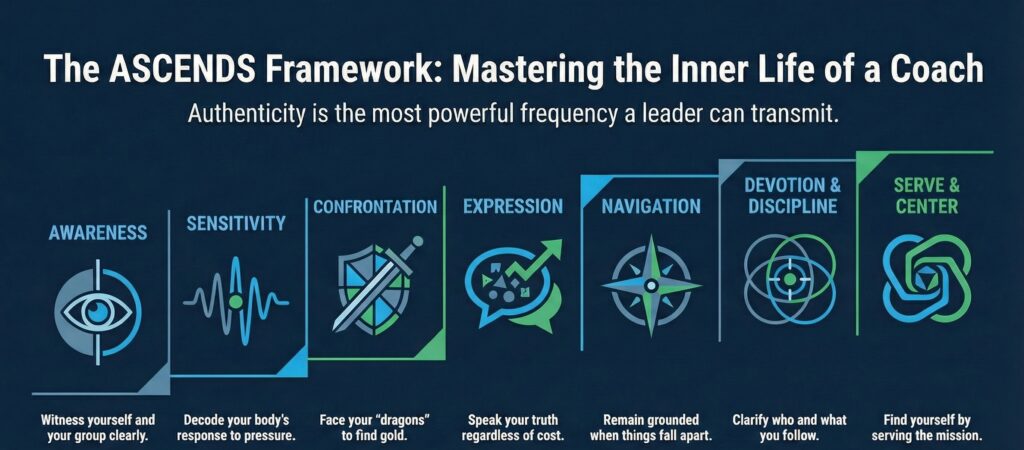
Harrington organizes this work into a seven-stage framework he calls ASCENDS.
Awareness: What do you actually see in yourself and in your group?
Sensitivity: What do you feel in your body during pressure moments?
Confrontation: What is the dragon, and are you willing to face it?
Expression: Can you speak your truth, even when it costs you something?
Navigation: Can you stay grounded when things fall apart?
Devotion and Discipline: What and who are you actually following?
Serve and Center: What do you serve? The answer to that question leads you back to yourself.
It is not a linear checklist. It is a continuous practice.
What This Requires Operationally
Harrington’s argument lands harder when the operational side of coaching is still running on group chats, scattered spreadsheets, and chased-down payments.
You cannot work on your inner game when your outer environment is in chaos.
EasyCoach handles the operational layer so coaches can focus on the human one. Scheduling, registration, payments, player communication, session planning, evaluations, and development tracking share one connected foundation. When the day-to-day runs without friction, coaches have room to do the work Harrington is describing.
EasyCoach Core covers administration, communication, and essential coaching tools. EasyCoach Pro adds a stronger coaching standard, player management workflows, and medical tracking. EasyCoach Elite includes scouting and analytics for clubs building deeper development visibility.
The coaches who win the next decade will not be the ones with the best data. They will be the ones who understand what moves people. That work starts with understanding yourself.
For the full webinar recording go to our partner Football Webinars.
Frequently Asked Questions
Coaching badges focus almost entirely on external elements: tactics, systems, and formation work. There is no formal curriculum for the emotional and psychological foundations of the coach as a person.
Authenticity occurs when what you say and what you genuinely believe are the same. It is the condition for real trust between a coach and a group.
Usually, because they do not feel safe to fail, the internal question is “what if?” What if I make a mistake and the coach reacts badly? When that fear is present, creative expression shuts down.
Vulnerability creates the conditions for growth. When a coach is willing to admit uncertainty or speak an uncomfortable truth, it signals to players that the environment is safe. Players who feel safe take risks. Risks lead to development.
A seven-stage personal development model: Awareness, Sensitivity, Confrontation, Expression, Navigation, Devotion and Discipline, Serve and Center.
EasyCoach is the connected platform for football clubs, academies, and federations. It connects daily operations, professional coaching methodology, and player-development data on one shared foundation.
Run it like the pros.
The platform Villarreal CF runs on.
See EasyCoach on your club or your federation. Book a 20-minute demo with our team.

Modern Trends for Set-Piece Success
Modern Trends, Edge-of-the-Box Exploitation, and Effective Coaching Strategies
Marko Krnjić: 5 Key Insights for the Modern Football Coach
Lessons from a Career in Elite Performance

The Skill of Being Yourself: A Guide to Human-Centric Coaching
Practical Lessons on Mentorship, Practice Design, and Fostering Belonging