


The “Win Your Mind” Philosophy:
Avram Grant’s Blueprint for Modern Football
Part one of a three-part series based on a masterclass session hosted by Nir Levin.
⚡ TLDR — Quick Summary
- Grant’s “Win Your Mind” framework evaluates players on three pillars: Talent, Passion, and Mental Strength.
- Remove any one and a player cannot reach the top.
- Talent alone is not enough. Passion means doing the hard work daily, not just wanting to win.
- Mental strength means using pressure as fuel, not fearing it.
- On man-management: fight with the player, not against them.
- Discipline is a cost-benefit tool, not a moral stance.
- Motivation runs roughly 80% on the desire to succeed, 20% on the fear of failure. A compliment almost always beats a slap.
Avram Grant has coached at every level of the game. He started at 18 as a youth coach at Hapoel Petah Tikva, won four Israeli Premier League titles across spells at Maccabi Tel Aviv and Maccabi Haifa, and managed the Israel national team for four years. In England, he took charge of Chelsea after Jose Mourinho’s departure and led the club to the 2008 Champions League Final, the League Cup Final, and a Premier League title race that went to the final day.
He went on to manage Portsmouth, reaching the 2010 FA Cup Final, and later West Ham and Partizan Belgrade, where he won the Serbian championship. Internationally, he coached Ghana to the 2015 Africa Cup of Nations Final and has since managed the Zambia national team.
The Triangle: Talent, Passion, Mental Strength
Grant’s player development model sits on three pillars. Remove any one of them and the whole thing collapses. No amount of investment in a club management platform or scouting database changes that equation.
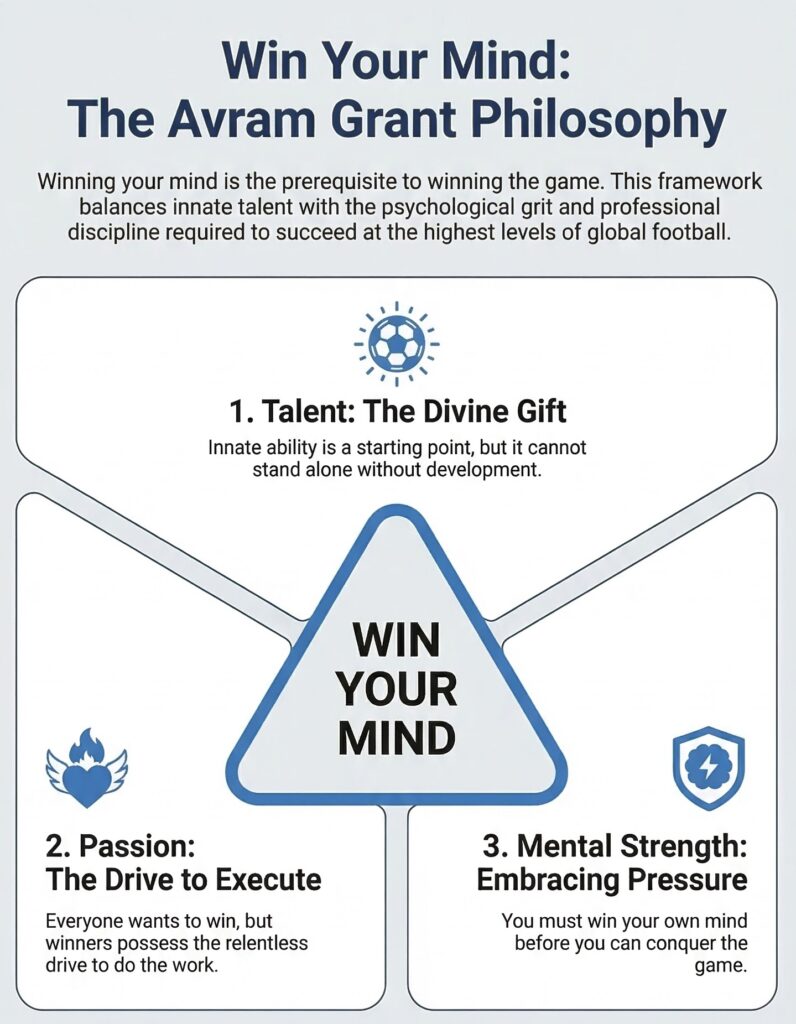
Talent
Talent is the obvious starting point. It catches the eye first. Grant calls it a “divine gift” and agrees it is non-negotiable. But he also warns against becoming a prisoner of it. His favourite example comes from basketball: Michael Jordan was the third pick in his draft. Kobe Bryant was the thirteenth. Neither was considered the most talented player available that year. Both became the greatest of their generation.
The takeaway for youth development is blunt. If your entire evaluation system is built around identifying raw talent and nothing else, you will miss the players who actually make it. Every coaching platform can track technical ability. Fewer track what sits underneath it.
Passion
Passion is where Grant draws a hard line between wanting success and doing the work that produces it. Everyone wants to win. That is not passion. Passion is the willingness to take the difficult, repetitive, unglamorous steps required to improve. Every single day. When no one is watching.
Grant pictures success as a pyramid. The goal sits at the top. The steps to get there are brutal. Passion is what makes a player climb them anyway.
Mental strength
Mental strength is the pillar Grant had to fight hardest to defend. Early in his career in Israel, critics dismissed his focus on psychology. Their argument: professional players are paid to perform, not to sit on a therapist’s couch. Grant ignored them.
His counterargument is simple. Football is a pressure sport. Not just pressing on the pitch. Pressure from fans, from media, from yourself. If you approach a match completely relaxed, it means you do not care enough. Pressure is not the enemy. It is the engine. The players and coaches who learn to use it, rather than hide from it, are the ones who win when it matters.
Man-Management: 25 Individuals, One Team
Even with the right triangle in place, a coach still has to deal with reality. A squad of 25 players means 25 different backgrounds, temperaments, and motivations. Grant puts it plainly: you might have a player who grew up wealthy sitting next to one who grew up with nothing. One with a university degree next to one who left school at twelve. And yet the player who left school might have a footballing intelligence that makes him the most important person in the room.
The job of a coach is not to flatten those differences. It is to get all of them pulling in the same direction. Grant’s phrase: fight with the player, not against them. Extract their best for the team.
This applies directly to discipline. Grant treats it as a tool, not a principle. He shared a story from his Chelsea days about a talented but disruptive Italian player the club wanted to sign for $80 million. Grant’s response: if the player scores 18 goals a season, the headache is not worth it. If he scores 30, it is. That is not cynicism. It is honest cost-benefit analysis, the same kind of thinking any club director applies when evaluating whether a new coaching platform or staff hire is worth the investment.
The 80/20 Rule of Motivation
Grant closes this part of his philosophy with a ratio. He estimates that athletes are driven roughly 80% by the desire to succeed and 20% by the fear of failure. A compliment, he says, is almost always better than a slap.
That does not mean avoiding hard conversations. It means understanding that positive reinforcement builds more than criticism breaks. The best club management platform in the world can surface performance data, flag attendance patterns, and track development milestones. But none of it matters if the coach delivering the feedback does not understand who they are talking to and what that person needs to hear.
Grant’s “Win Your Mind” framework is not a mental health initiative bolted onto a football programme. It is the foundation the programme is built on. Talent without passion stalls. Passion without mental strength crumbles under pressure. And a team full of talented, passionate, mentally strong players still needs a coach who knows how to manage human beings, not just tactics.
In Part 2, we will look at how Grant applied these principles in real time at Chelsea, Portsmouth, and across his international career.
Frequently Asked Questions
“Win Your Mind” is Grant’s player development framework built on three pillars: Talent, Passion, and Mental Strength. The core idea is that a player must win the internal battle before they can win on the pitch. Grant argues that missing any one of these three elements makes it impossible to reach the highest level.
Grant started coaching at 18 with Hapoel Petah Tikva’s youth team in Israel. He won four Israeli Premier League titles with Maccabi Tel Aviv and Maccabi Haifa, managed the Israel national team for four years, then moved to England where he coached Chelsea, Portsmouth, and West Ham. He also managed Partizan Belgrade (winning the Serbian title), the Ghana national team (reaching the 2015 AFCON Final), and Zambia.
Grant uses three criteria: Talent (natural ability), Passion (the drive to do the hard daily work), and Mental Strength (the ability to perform under pressure). He warns against overvaluing raw talent alone, pointing to Michael Jordan (drafted third) and Kobe Bryant (drafted thirteenth) as examples of players whose passion and mental strength mattered more than their draft position.
Grant treats discipline as a practical tool, not a moral principle. He applies a cost-benefit lens: a disruptive player who scores 18 goals is not worth the trouble, but one who scores 30 might be. His broader philosophy is to fight with players to extract their best, not against them. He estimates athletes are driven 80% by the desire to succeed and 20% by fear of failure.
Youth clubs can use Grant’s framework to build evaluation and development programmes that go beyond technical ability. A club management platform can track performance data, but coaches also need to assess passion and mental resilience when making development decisions. Grant’s approach reinforces that coaching consistency across teams, combined with an understanding of individual psychology, is what separates good programmes from great ones.
Grant argues that football is defined by pressure, not just tactical pressing but the psychological weight of expectations from coaches, parents, and the players themselves. Players who learn to use that pressure as motivation rather than shrink from it are the ones who perform in high-stakes moments. For any coaching platform tracking player progress, mental resilience is as important a development indicator as physical or technical metrics.
Ready to Put Analytics Into Practice?
EasyCoach brings all your player data, session planning, communication, and medical tracking into one platform — so you can coach smarter, not harder.