Why Your Half-Time Speech Is Probably Failing
TL;DR
- Stop over-talking and start structuring.
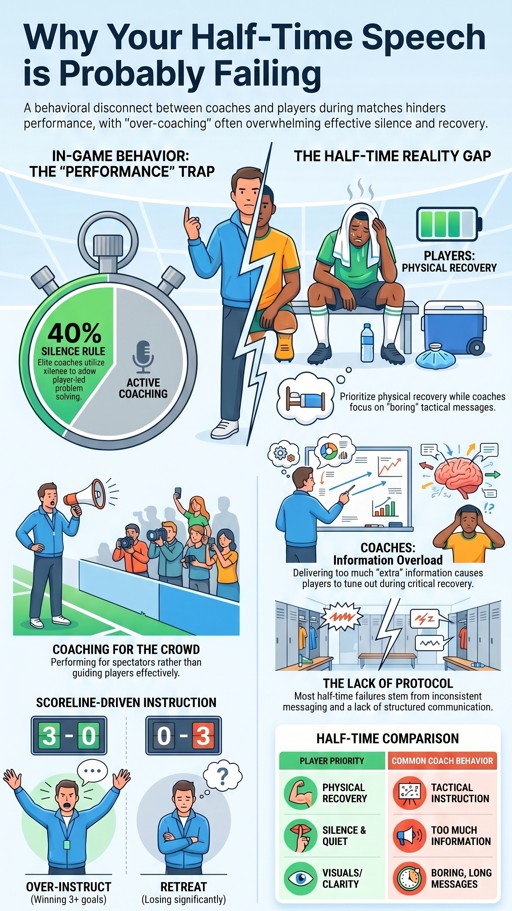
- Research shows a massive disconnect between what coaches think players need on matchday and what players actually want: physical recovery over boring, information-heavy lectures.
- Elite coaches use silence effectively (about 40% of the time) and rely on strict protocols.
- Keep it simple, reduce the noise, and focus on key messages.
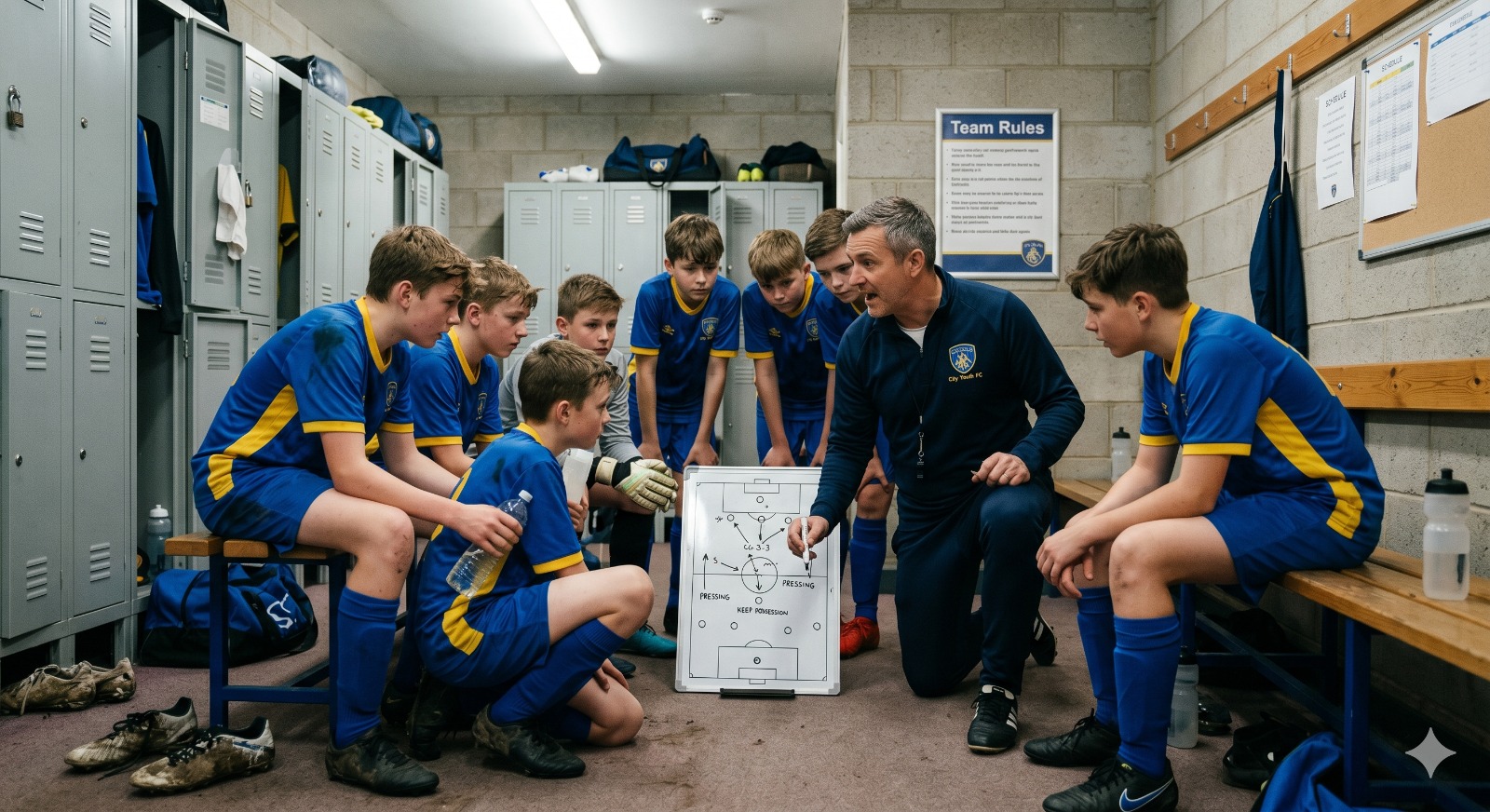
The damp scent of the pitch, the ringing in your ears from a frantic first half, and the “white noise” of shouting parents and emotional players. This is the matchday reality – a sensory minefield where tactical clarity often goes to die. In the heat of the moment, most coaches default to volume, pacing the technical area and filling every pocket of air with “instruction.”
Our analysis shows a harsh reality: “Effective Competition Behaviours” are rarely taught or practiced, leading to staggering amounts of wasted energy and inconsistent messaging. Elite performance isn’t about who shouts the loudest, it’s about the surgical application of “Marginal Gains” in communication.
The Power of Silence: The 40% Rule
In development football, there is a lingering myth that a silent coach is an inactive one. In elite environments, silence is a deliberate performance behavior. Data indicates that elite coaches are silent 40% of the time during active play.
While the average development coach is exhausting themselves with a running commentary, the masters are observing. Take Brighton’s Fabian Hürzeler as a benchmark, he spends 44% of his time in the dugout, removed from the immediate chaos of the touchline to maintain a bird’s-eye view of the tactical structure.
To apply this, when you do speak, your interventions should fall into the four categories identified by Hastie (1999):
- Technical: Specific execution.
- Tactical: Positioning and systems.
- Psychological: Motivation and focus.
- Other: Necessary administrative cues.
The Scoreline Trap: Coaching for the “show”
Coaching behavior often shifts dramatically based on the scoreboard, but the shift is frequently driven by “Impression Management” rather than player needs. We see a clear data-driven trend:
- Winning by 3+ goals: A massive spike in instruction (560 recorded instances).
- Winning or Losing by 2 goals: Moderate levels of instruction (323 instances).
- Losing by 3+ goals: A significant “shut down” (only 60 instances).
When winning, coaches over-coach to associate themselves with the success. When losing, they withdraw to distance themselves from failure. Contrast this with the calculated presence of Mikel Arteta, who maintains a high technical area presence (35% in the central box) regardless of the scoreline to provide a constant tactical anchor, or Pep Guardiola, who focuses 25% of his presence on specific tactical zones to influence play.
The hallmark of a master writer is knowing what to cut. The hallmark of an elite coach is knowing what not to say. Shift your focus from “performance for show” to “performance for impact.” Reduce your information, adopt a protocol, and stick to key messages that can fit on a urinal-side flyer.
Insights provided by Ashley Gumbrell of St Mary’s University. Ashley is a leading researcher and performance coach with affiliations including the FA, Fulham FC, Brighton & Hove Albion FC, and UK Coaching.
For the summary of the previous webinar with Louis Harrington read The Inner Game coaching article.
For the full webinar recording, go to our partner Football Webinars.
Frequently Asked Questions
Probably. Studies show that elite coaches actually utilize silence about 40% of the time. While a big lead (winning by 3+ goals) often triggers more instruction, constant sideline shouting is frequently just “impression management” – essentially, putting on a performance for the crowd rather than actually helping the team. Over-coaching mid-game leads to inconsistent messaging and wasted energy
Coaches and players fundamentally disagree on what half-time is for. Coaches tend to focus on unloading tactical and technical information, which players often process as “too much information” and “boring messages”. Players, on the other hand, prioritize physical recovery, eating/drinking, and prefer clear visual aids or storytelling when tactics are discussed
To avoid overwhelming your players with “too much extra information” or wasting energy on inconsistent messages, your interventions need to be highly intentional. According to research by Hastie (1999), effective coaching behaviors and communication should fall strictly into one of four categories: Technical, Tactical, Psychological or Other (Any necessary administrative cues, such as managing substitutions or communicating time remaining)
Run it like the pros.
The platform Villarreal CF runs on.
See EasyCoach on your club or your federation. Book a 20-minute demo with our team.
Modern Trends for Set-Piece Success
Modern Trends, Edge-of-the-Box Exploitation, and Effective Coaching Strategies
Marko Krnjić: 5 Key Insights for the Modern Football Coach
Lessons from a Career in Elite Performance

The Skill of Being Yourself: A Guide to Human-Centric Coaching
Practical Lessons on Mentorship, Practice Design, and Fostering Belonging