
TL;DR
Paul Barry, former Head of Coaching at Crystal Palace, breaks player decision-making into four stages: Identify, Decide, Execute and Action (I.D.E.A.). Players read time, space, teammates and opponents before the ball arrives, choose a first touch that entices, evades or eliminates, and plan their next move before the current one is over. Coaches should judge the decision first and the technique second.
In a webinar hosted by Football Webinars, former Crystal Palace Head of Coaching and Arsenal Academy coach, Paul Barry, shared a comprehensive breakdown of the I.D.E.A. Framework. Drawing from nearly 30 years of experience across grassroots football, professional academies, and coach education, Barry presented a method for transforming how coaches view player development.
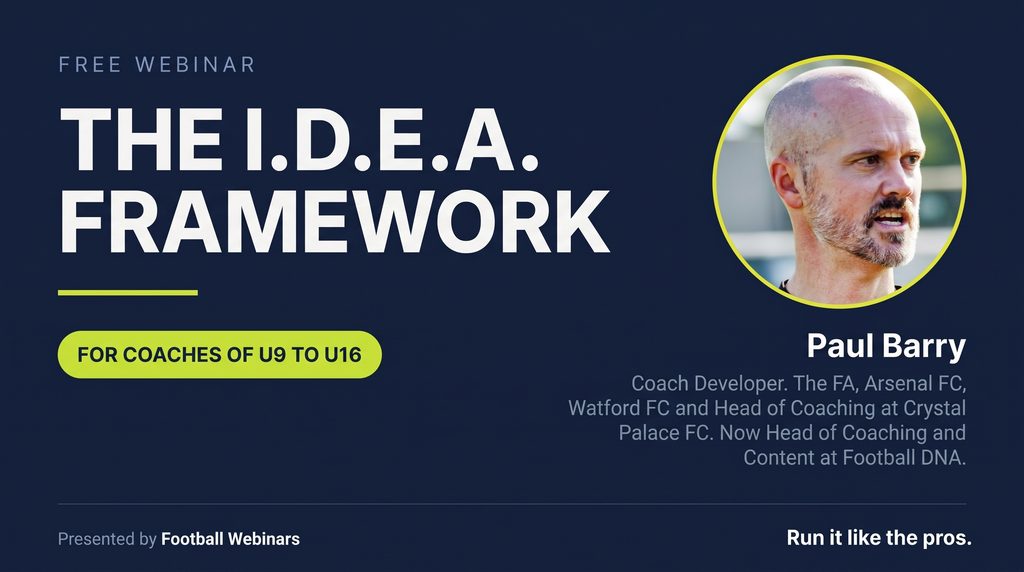
Inspired by prominent Dutch coach educators, Barry adapted these concepts to create a practical logical thought process that players experience in every phase of the game.
What is the I.D.E.A. Framework?
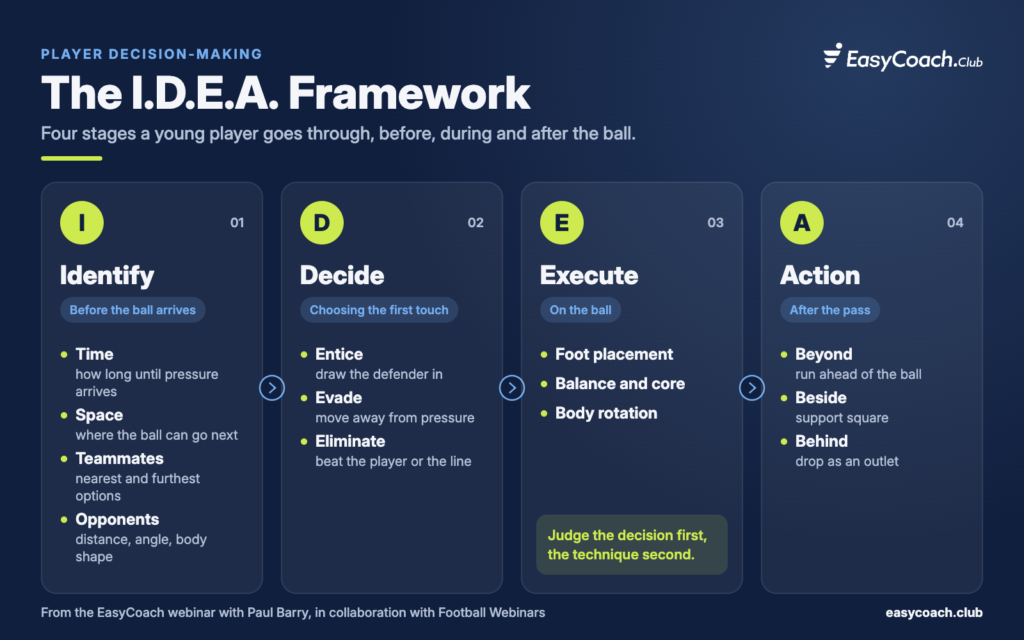
The I.D.E.A. framework is an acronym outlining the logical decision-making model young players navigate before, during, and after interacting with the ball:
I: Identify (Before Phase 1)
D: Decide (Before Phase 2)
E: Execute (During Phase)
A: Action (After Phase)
1. Identify (Before Phase 1)
Before a player receives the ball, they must constantly gather environmental context. Barry highlights four key variables every player must interpret:
Time: Assessing how much time is available before pressure arrives, reading the weight and speed of a pass, and judging the trajectory of the incoming ball.
Space: Determining where space exists to move or redirect the ball, as well as evaluating space available around teammates.
Teammates: Scanning for nearest and furthest passing options while adjusting body orientation to keep both the passer and target options in sight.
Opponents: Evaluating nearest defender distance, angle of approach, and body shape to anticipate an incoming press.
2. Decide (Before Phase 2)
Barry breaks down the execution intent of a first touch into three categories:
Enticing Touch: A controlled, “dead” touch (often referenced via Michael Carrick’s receiving style) that draws a defender closer to open space behind or around them.
Evading Touch: Directs the ball away from pressure to create more time and space without necessarily beating the defender.
Eliminating Touch: Takes a player past an opponent or breaks a defensive line to attack open space.
3. Execute (During Phase)
Execution represents the physical “how” behind a decision. Occurring during the active phase when a player is in contact with the ball, execution is the moment a player physically transforms their spatial awareness and game insight into technical movement. A player’s execution depends entirely on performing a technical action in direct response to their prior decision and environment identification.
High-level technical execution relies on precise micro-adjustments, such as subtle foot placement, balance of the center of gravity, core balance, and body rotation, which allow a player to maintain control and power following a split-second decision. Novice or younger players frequently experience technical deficiencies or physical limitations during execution, often resulting in misplaced passes or loose touches despite making the correct decision.
Because the decision must always precede the execution, coaches should prioritize and praise a player’s initial intent and decision-making over the final outcome, knowing that technical consistency and physical capabilities naturally refine over time through practice, growth, and maturation.
4. Action (After Phase)
The final stage is the secondary action following a pass or play. Barry introduced the 3 B’s to help players decide their next movement:
Beyond: Making an attacking run into space ahead of the ball.
Beside: Moving square to provide support if the ball-carrier faces heavy pressure.
Behind: Dropping back to offer defensive stability or a resetting outlet.
For those looking to dive deeper into these high-level tactical setups, the full recording of the presentation is now available to watch on Football Webinars.
FAQ
Young players often make the correct decision based on their environment, but fail technically due to physical limitations, balance, or micro-adjustment errors (like foot placement). Because decision-making must precede execution, coaches should praise the correct intent, knowing that technical precision and physical control develop naturally over time through maturation and practice.
During the Identify phase, a player must continuously scan and gather contextual information from four key variables in their surroundings. First, they need to read Time by judging the speed, weight, and trajectory of the incoming pass to gauge how quickly pressure will arrive. Second, they assess Space to locate open turf for receiving or redirecting the ball, while also checking space near teammates. Third, they identify the positioning of Teammates, adjusting their body shape to keep both the passer and potential target options within their field of vision. Finally, they evaluate Opponents by judging the nearest defender’s distance, approach angle, and body posture to anticipate incoming pressure before the ball arrives.
Execution is the physical manifestation of a decision during the moment of ball contact, where a player translates their spatial awareness into technical actions through precise physical mechanics like core balance, foot placement, and body rotation. Because younger players often have physical or technical limitations, they may execute a poor pass or touch even when they correctly identified the situation and made the right tactical choice. As a result, coaches are encouraged to prioritize and praise the player’s underlying decision and tactical intent rather than focusing solely on the physical result, knowing that technical control and physical consistency naturally refine over time through growth and targeted practice.
EasyCoach gives coaches one shared place to plan training to the club standard. The Coaching Center includes a library of 2,000 drills and sessions, a tactical drawer and a session planner, so a coach can build a session around one stage of the model, such as first-touch intent or the next movement after a pass, and share it with staff and players through the app. Every age group works from the same methodology, and less pitch time goes on explaining the drill.

Modern Trends for Set-Piece Success
Modern Trends, Edge-of-the-Box Exploitation, and Effective Coaching Strategies
Sep 19, 2026
How to Use Sports Analytics to Improve Team Performance
A practical guide for coaches on using data and analytics to make smarter decisions, reduce injuries, and develop players. Includes the 5…
Mar 4, 2026
The Hidden Language of Player Behaviour
Why modern coaching demands a trauma-informed lens.
Aug 25, 2026