Bad Coaching is the #1 Reason Young Athletes Walk Away From Youth Sports

TL;DR
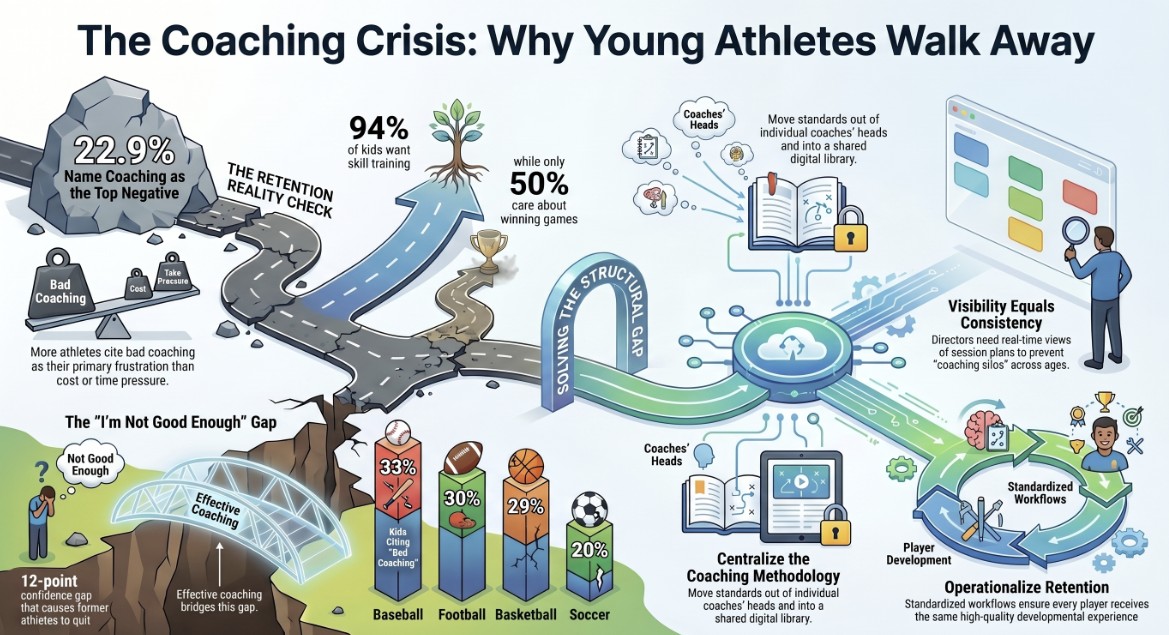
In the Aspen Institute’s 2025 Youth Athlete Survey, 22.9% of current youth athletes named “bad coaching” as what they like LEAST about playing organized sports. It is the most-cited negative experience in the entire study, ranking ahead of cost (18.5%), time pressure (18.4%), and self-doubt (16.1%). Among former athletes, the same complaint ranks second behind only “I’m not good enough.” Soccer outperforms most US youth sports on this metric, but 1 in 5 current soccer players still cite bad coaching as their top complaint. For clubs, this is operational. Coaching consistency across every team is the line between retention and churn, and it cannot live in individual coaches’ heads.
The Aspen Institute’s 2025 Youth Athlete Survey is the largest national study of youth sports participation in years. It surveyed 3,827 kids across all 50 states, including current athletes, former athletes, and youth who have never played organized sports. The data should reshape how every club, academy, and federation thinks about coaching.
Bad coaching is the number one complaint among kids currently playing youth sports. Not cost. Not time pressure. Not injury risk. Coaching.
What kids actually want from a coach
The Aspen study asked young athletes what they think their coach’s role should be. The answers were unambiguous.
94.4% said a coach’s job is to teach sports skills. 85.4% said a coach’s job is to develop life skills. Only 50.4% said a coach’s job is to win games and competitions.
Kids are not asking their coaches to chase trophies. They are asking to be taught and developed. When that does not happen consistently, they leave.
Where the gap actually shows up
The U10 team gets one approach. The U12 team gets a different one. The U14 team runs on whatever the new assistant coach picked up at a clinic three seasons ago. The director of coaching has no real visibility into what is being taught at any given age group, on any given week.
This is the problem the Aspen data exposes. When nearly a quarter of current youth athletes name bad coaching as their top frustration, the issue is almost never one bad coach. It is structural. Sessions are not planned against a shared methodology. Drills are not aligned across age groups. Coach behavior on the field is not observable to the people responsible for it.
A coaching platform that runs as part of the club management platform fixes that. Session plans become visible to the director of coaching. Drills come from a shared library. Methodology is enforced inside the workflow, not in a pre-season slide deck that nobody opens again.
How soccer compares to other US youth sports
The Project Play analysis of the Aspen findings broke this down by sport. Soccer is doing better than most US youth sports on the bad coaching metric, but it is not exempt from the broader pattern.
| Sport | Top complaint: “Bad Coaching” |
| Baseball | 33% |
| Football | 30% |
| Basketball | 29% |
| Soccer | 20% |
| Tennis | 20% |
Source: Project Play / Aspen Institute analysis of the 2025 National Youth Athlete Survey.
Soccer clubs have something to defend. The coaching experience in soccer is, on average, better than the coaching experience in baseball, football, and basketball. As Project Play’s Jon Solomon noted in the summary, “the culture problems in youth sports are often sport-specific.”
But 1 in 5 current soccer players still naming bad coaching as their top complaint is not a number to celebrate. It is a number that says soccer’s floor is higher than its ceiling. The clubs winning that 20% back are the ones running a coaching standard you can actually see across teams.
The retention math is in the data
Look at one parallel finding. Among former athletes, 28.6% said the reason they stopped playing was “I’m not good enough.” Among current athletes, only 16.1% feel that way.
That 12-point gap is what coaching does. Kids who feel they are improving stay. Kids who feel stuck leave. The coach is the variable that determines which group a player ends up in.
For a club running 20 teams, the implications are real. The difference between a 5% and a 15% drop-off rate per season is dozens of players. At standard youth soccer pricing, that is real revenue. More importantly, it is real kids walking away from a sport they used to love.
What it means for directors of coaching
If you run a club, the implication is direct. The coaching standard cannot sit in your head. It cannot live in a single pre-season meeting that everyone forgets by Week 3. It has to live in the workflow your coaches use every week.
Session planning happens inside a system you can see. Evaluations run on a shared rubric. Methodology is documented and accessible to every coach on staff. The DOC has a real-time view of what is being taught at every age group, and can step in before a coach develops a habit that costs the club players.
This is not about micromanaging coaches. It is about giving every coach the structure to do their job well, and giving the director the visibility to support them. Clubs that run this way produce a different quality of player experience. The Aspen data tells us the kids notice.
What’s coming next in the series
This is the first post in a three-part series on what the 2025 Youth Athlete Survey means for youth soccer clubs and academies. Next: parent behavior, and the role it plays in why kids leave the game.
Further reading
The Aspen Institute’s full 2025 Youth Athlete Survey is available through the Aspen Institute Sports & Society Program. For a topline summary of the 15 most significant findings, see Jon Solomon’s Project Play analysis.
FAQ
A national study of 3,827 youth across all 50 states and the District of Columbia, conducted by the Aspen Institute’s Sports & Society Program with researchers at Utah State University and Louisiana Tech University. Data was collected between October and December 2025 and published in April 2026. It captures perspectives from current athletes, former athletes, and kids who have never played organized sports.
Relative to other sports surveyed, yes. The Project Play analysis of the Aspen findings shows that 20% of current soccer players name bad coaching as a top complaint, compared to 33% in baseball, 30% in football, and 29% in basketball. Soccer is doing better, but not well enough.
Bad coaching is the most-cited negative experience among current youth athletes (22.9%). For former athletes, it ranks second behind self-doubt about ability (“I’m not good enough” at 28.6%). Cost, time, and injury risk all rank lower.
94.4% say it is to teach sports skills. 85.4% say it is to develop life skills. Only 50.4% say it is to win games. Kids see the coach as a developer first, a competitor second.
By moving the coaching standard out of individual coaches’ heads and into a shared system. Session planning, methodology, evaluations, and player progress tracking should all run through one coaching platform that the director of coaching can see across every team. That is the operational shift.
By making the coaching standard part of the weekly workflow rather than a document. When session planning, methodology, evaluations, and player development tracking run on one connected platform, every coach works to the same standard and the director of coaching has visibility across every team. EasyCoach is the connected platform clubs run on to make that standard consistent, with operations and coaching in one place.
Run it like the pros.
The platform Villarreal CF runs on.
See EasyCoach on your club or your federation. Book a 20-minute demo with our team.

Modern Trends for Set-Piece Success
Modern Trends, Edge-of-the-Box Exploitation, and Effective Coaching Strategies
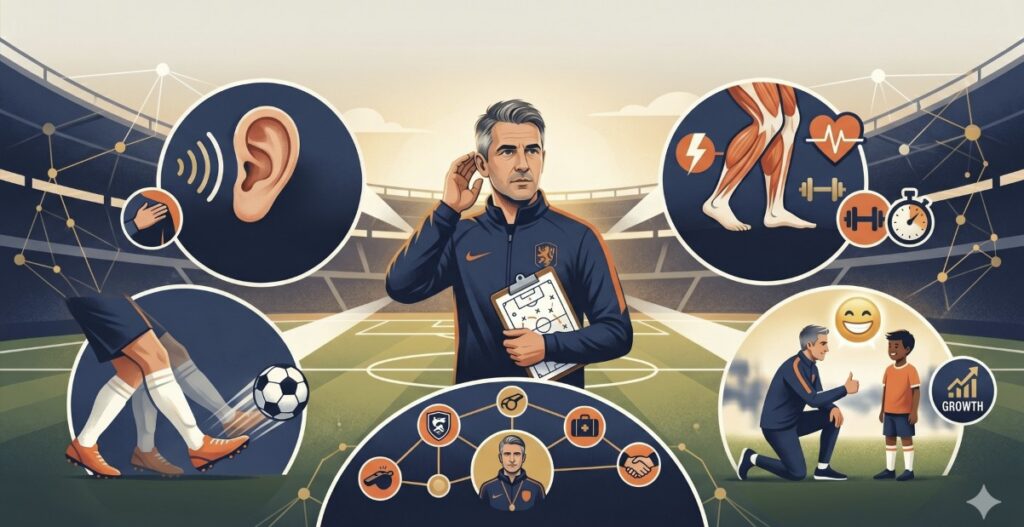
Marko Krnjić: 5 Key Insights for the Modern Football Coach
Lessons from a Career in Elite Performance
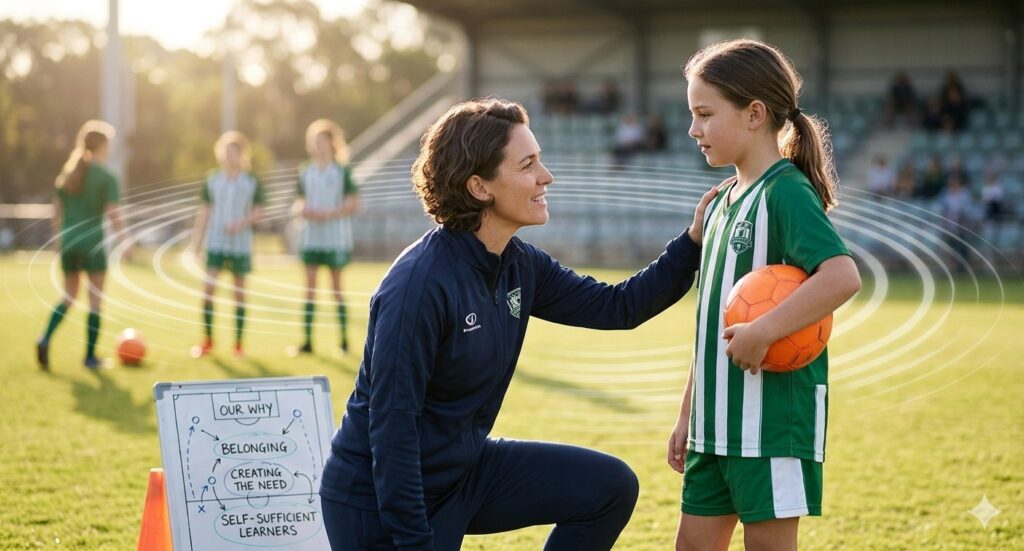
The Skill of Being Yourself: A Guide to Human-Centric Coaching
Practical Lessons on Mentorship, Practice Design, and Fostering Belonging