What Soccer Is Doing for American Kids, and Where It Is Losing Them

TL;DR
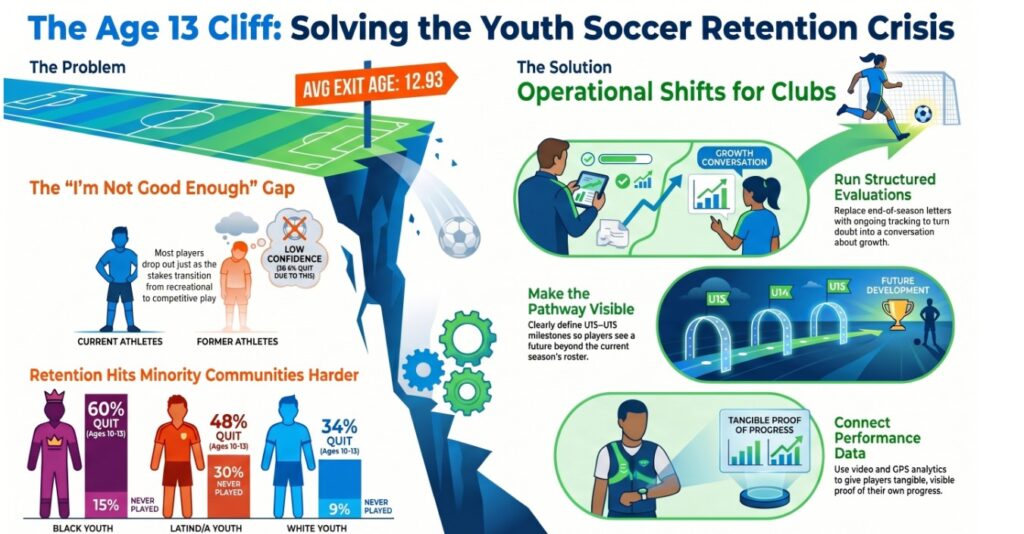
The Aspen Institute’s 2025 Youth Athlete Survey shows soccer is the most-played youth sport in the US and that kids who play it report substantial benefits: 89.4% say sport improves their physical health, 83.7% say it improves social connectedness, and 81.1% say it improves their mental state. The challenge is retention. The average former youth athlete stopped playing at age 12.93. The cliff is steeper for some demographics than others. 30% of Latino/a youth have never played organized sports at all, the largest never-played share of any major demographic group. Cost is part of the picture, but the bigger driver is identity: the share of kids who say “I’m not good enough” jumps from 16.1% among current athletes to 28.6% among former athletes. Clubs cannot solve cost on their own, but they can solve the development-visibility problem that pushes the “I’m not good enough” group out of the sport. The fix is operational.
Soccer is the most-played organized youth sport in the United States. According to the Aspen Institute’s 2025 Youth Athlete Survey, 53.4% of current youth athletes have played organized soccer at some point in their lives. It outranks basketball (49.8%), swimming (30.9%), volleyball (30.7%), and every other sport surveyed.
Soccer also crosses demographics in a way most US sports do not. Among current Hispanic/Latino youth athletes, soccer is the single most-played sport (41.6%). Among current Caucasian/White youth athletes, it ranks among the top three (57.2% lifetime participation). Among kids who have never played organized sports, soccer is still the sport they have most casually tried with friends and family (28.3%).
The participation is there. The benefits, by the kids’ own report, are there too. The challenge is what happens around age 13.
What soccer is doing right for kids who play
Before getting to the dropout problem, the data on what soccer is doing for the kids who stay deserves attention.
89.4% of current youth athletes say sport improves their physical health. 83.7% say it improves their social connectedness. 81.1% say it improves their mental state. 64.9% say it improves their control of their emotions.
For a generation of kids that the public health conversation has largely written off as digitally distracted, anxious, and disconnected, this is significant data. The kids in the system are reporting real, durable benefits. They are not just playing because their parents enrolled them. 92.9% of current athletes say they play because “it is enjoyable and satisfying.” 90.0% say it is “important and has value.”
When kids stay, soccer works. That is the headline that often gets buried. The job of US youth soccer clubs is not to invent benefits the kids don’t see. The job is to keep more kids in long enough to receive the benefits the data already confirms are there.

Where the sport is losing them
The Aspen study captured the age at which former athletes stopped playing. The numbers are worth reading carefully.
5.7% stopped at age 11. 10.5% stopped at age 12. 13.0% stopped at age 13. 10.2% stopped at age 14. 11.3% stopped at age 15. 12.3% stopped at age 16. The average former athlete stopped at age 12.93.
The peak dropout window is the years where most clubs raise the stakes. Travel or rec. A team or B team. Pre-academy or recreational league. The transition from recreational to competitive youth soccer is the moment a 12-year-old’s confidence in their own development matters most. It is also the moment most clubs make that confidence harder to build.
Who is leaving, and who never started
The Project Play analysis of the Aspen findings highlighted demographic patterns the headline numbers can hide. The cliff is steeper for some kids than others. The never-played pool is much larger for some groups than others. Both findings matter for US soccer.
Among kids who quit organized sports between the ages of 10 and 13, 60% were Black, 48% were Latino/a, and 34% were White. The dropout window we have been describing as a youth sports problem is, more precisely, a youth sports problem that hits harder in some communities than in others.
| Demographic group | Quit at ages 10 to 13 | Never played organized sports |
| Black youth | 60% | 15% |
| Latino/a youth | 48% | 30% |
| White youth | 34% | 9% |
Source: Project Play / Aspen Institute analysis of the 2025 National Youth Athlete Survey.
The never-played number for Latino/a youth is the most significant data point in the entire study for US soccer. Latino/a youth are the demographic group most likely to play soccer when they are in the system. They are also the group with the largest untapped pool sitting outside it. 30% of Latino/a youth have never played organized sports, more than triple the rate among White youth.
Safety perception is part of why. Among current Latino/a players, 55% say injury risk has kept them from choosing a specific sport, compared to 24% of Black players and 21% of White players. For a sport built on long-term skill development and broad participation, the gap to close is real, and it is a participation problem before it is a development problem.
For US soccer specifically, this is structural. The growth of the sport in the next decade is heavily linked to the participation of Latino/a families. Clubs that want to grow have to engage that demographic on the terms it actually responds to: clear communication about safety, school-based and public-facility access, and lower-cost entry points.
The parent profile in soccer is uncomfortable to read
The Project Play summary also broke parent behavior down by sport. Soccer parents rank highest among the five sports analyzed on “getting angry/upset about performance” (16%) and on “comparing kids to other players” (18%). Both numbers run higher in soccer than in basketball, baseball, or football.
For a sport built on long-term skill development and player retention, a parent culture that defaults to comparison and frustration is working against the development model the clubs are trying to run. This is something clubs can shape, with the right communication structure and visible development frameworks.
The “I’m not good enough” problem
Among current youth athletes, 16.1% named “I’m not good enough” as a top complaint about their experience. Among former athletes, that number nearly doubles to 28.6%. It is the single largest gap between current and former athletes in the entire data set.
Read that again. The group that walked away from sport contains almost twice as many kids who decided they were not good enough as the group still playing.
This is not a coaching problem in the bad-coaching sense the first post in this series covered. This is a development-visibility problem.
When a 12-year-old does not see their own progress, they assume they are not progressing. When a 13-year-old does not understand what the next level looks like, they assume they cannot reach it. When a parent has no structured way to see development, they cannot reassure a kid who is in their head about it.
This is where club operations meet player development. A club that runs structured evaluations, gives players and parents real visibility into progress, and documents what each player is working on this season is doing more than collecting data. It is giving a 12-year-old a reason to stay.
Cost is part of the picture, not the whole picture
Cost matters. Among current youth athletes, 18.5% named “playing is too expensive” as a top complaint. Among low-affluence athletes specifically, that number rises to 23.9%. Among kids who have never played, 27.0% of the low-affluence group cited cost as a reason they would not start.
For US youth soccer, this is structural. Pay-to-play has built a system that filters by household income before it filters by talent. The Aspen data confirms what most directors of coaching already know: the player pool a club ends up developing is shaped more by family ability to write a check than by the kids’ actual potential.
But cost on its own does not explain the cliff. Visibility does.

What clubs can change
Cost is hard for an individual club to solve. The development-visibility problem is not. Three operational shifts move the retention curve.
Run real evaluations. Most clubs do an end-of-season letter and call it development tracking. The Aspen data is asking for something more specific. Players and parents need an ongoing view of progress against a defined standard. A coaching platform that supports structured player evaluations turns “I’m not good enough” into a conversation about what to work on next.
Make the development pathway visible. A 12-year-old who can see what U13, U14, and U15 look like is in a different headspace than one who only knows whether they made the A team this year. Clubs that publish their methodology, their development milestones, and their progression criteria give kids something specific to aim at.
Connect performance data to the workflow. Video, GPS data, and other analytics tools are everywhere now. The clubs winning the retention battle are the ones that turn that data into something a player can actually see, understand, and use. Data that sits in a separate tool nobody opens is wasted data.
The retention math
Among current youth athletes, only 13.2% believe they have the ability to play professional sports. 18.6% believe higher-level college. 18.5% believe lower-level college. The vast majority of kids playing youth sports are not aiming at professional careers. They are aiming at high school sports, college club teams, lifelong recreational players, and healthy adults.
So the conversation about retention is not really a conversation about producing professional players. It is a conversation about whether American youth soccer keeps a 13-year-old in the sport long enough for the benefits documented in the Aspen study to actually accumulate. The 81.1% improved mental state. The 83.7% improved social connectedness. The 89.4% improved physical health.
The cliff matters because the alternative is rarely “the kid takes up a different sport.” The alternative is the kid takes up a screen.
The series so far
This is the third post in a three-part series on what the 2025 Youth Athlete Survey means for youth soccer clubs and academies. The first post covered the coaching consistency crisis. The second covered parent behavior. This one closes on retention.
Further reading
The Aspen Institute’s full 2025 Youth Athlete Survey is available through the Aspen Institute Sports & Society Program. For a topline summary of the 15 most significant findings, see Jon Solomon’s Project Play analysis.
FAQ
The average former youth athlete stopped playing at age 12.93. The largest gap between current and former athletes is on the statement “I’m not good enough” (16.1% vs 28.6%), suggesting that loss of confidence in development progress is a primary driver of dropout, alongside cost (named by 23.9% of low-affluence current athletes).
According to the Project Play analysis of the Aspen findings, among kids who quit organized sports between ages 10 and 13, 60% were Black, 48% were Latino/a, and 34% were White. The cliff is materially steeper for Black and Latino/a youth than for White youth.
30% of Latino/a youth have never played organized sports, the highest non-participation rate of any major demographic group. Latino/a youth are also the group most likely to play soccer when they are in the system. The participation gap is, in effect, soccer’s largest growth opportunity in the United States.
The Aspen data shows cost is a meaningful barrier, especially for lower-income families. 23.9% of low-affluence current athletes name expense as a top complaint, compared with 16.3% of high-affluence athletes. 27.0% of low-affluence kids who have never played sport cite cost as a reason they would not start.
The peak dropout window is age 12 to 14, with an average exit age of 12.93 according to the Aspen Institute survey. This aligns with the transition from recreational to competitive youth sport in most US clubs.
EasyCoach is the connected platform clubs run on. Coaching methodology, player evaluations, development tracking, scheduling, communication, and payments all run in one platform. Directors of coaching get real visibility across every team. Players and parents get a structured view of development. Clubs get the operational backbone to keep more kids in the sport.
Run it like the pros.
The platform Villarreal CF runs on.
See EasyCoach on your club or your federation. Book a 20-minute demo with our team.

Modern Trends for Set-Piece Success
Modern Trends, Edge-of-the-Box Exploitation, and Effective Coaching Strategies
Marko Krnjić: 5 Key Insights for the Modern Football Coach
Lessons from a Career in Elite Performance

The Skill of Being Yourself: A Guide to Human-Centric Coaching
Practical Lessons on Mentorship, Practice Design, and Fostering Belonging