Marko Krnjić: 5 Key Insights for the Modern Football Coach
TL;DR
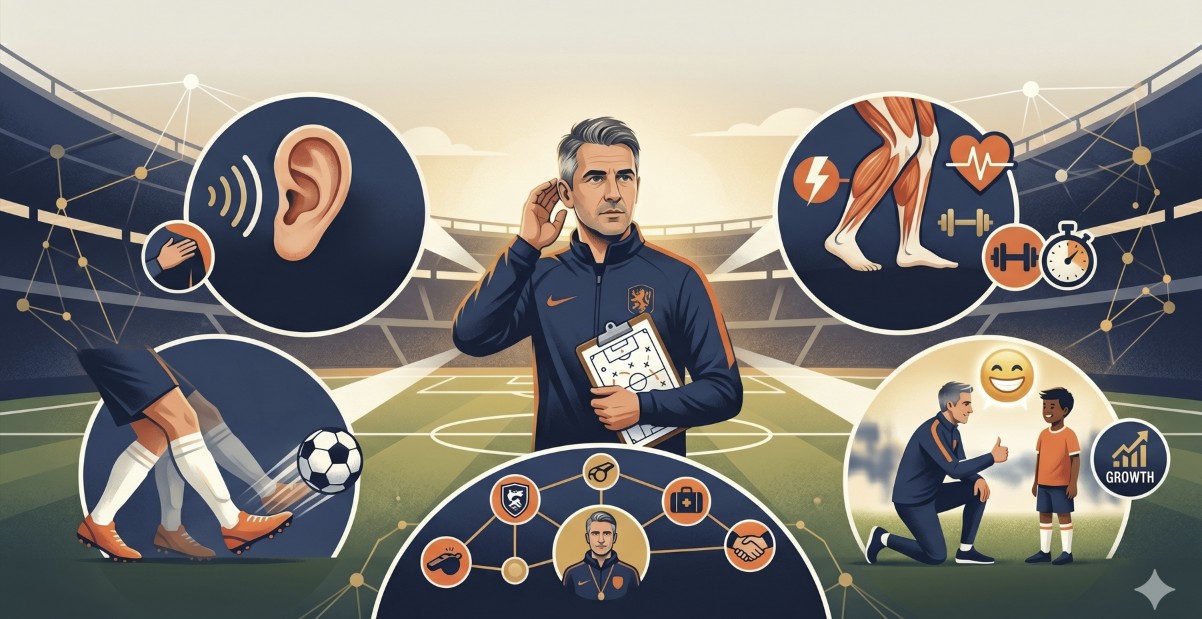
Marko Krnjić’s coaching philosophy is built on humility, technical mastery, and systemic awareness. His five core insights emphasize: listening over speaking, gaining a physical preparation “edge,” prioritizing high-volume technical repetition, focusing on player improvement over results at the grassroots level, and navigating the whole club through effective communication.
Marko Krnjić is a UEFA Pro Licence coach and the founder of Edge Football Analytics, a company dedicated to individual player analysis and coaching. Recently, EasyCoach hosted Marko for an in-depth webinar where he shared the wisdom he has gained from a career that began in the “muddy fields” of top-flight football and rose to the highest levels of the international game. This article explores Marko’s professional journey and highlights five essential lessons for the next generation of coaches.
1. Listen More Than You Speak (The Power of Mentorship)
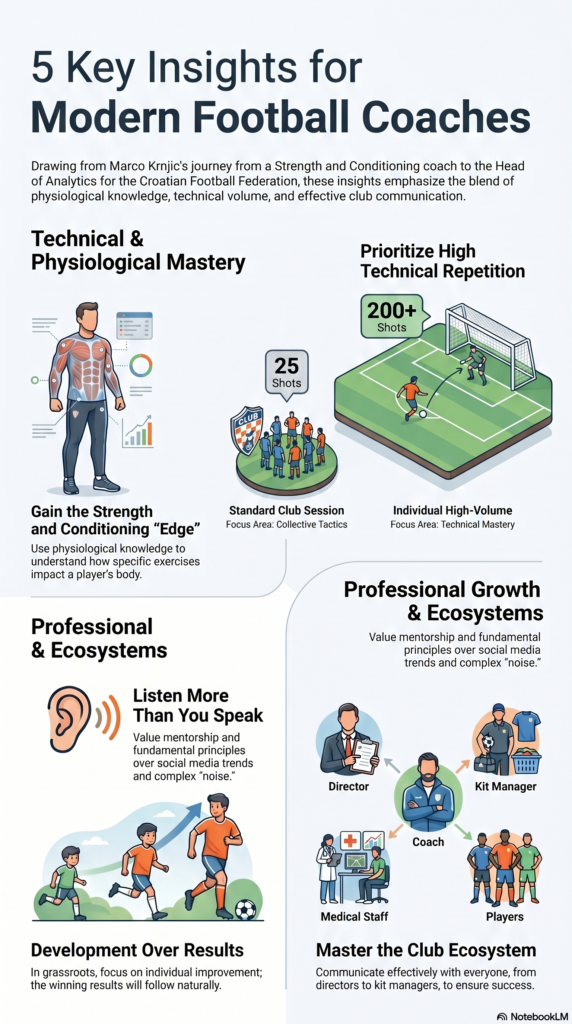
One of Krnjić’s most emphasized lessons for young coaches is to “listen more than you speak”. In an era where coaches are “bombarded” by social media drills and AI tools, he argues that the basics are often lost. He believes young coaches should focus on finding mentors to “steal” knowledge from in a positive way. Without his own mentors, like Luca Milanovich, Krnjić admits he would have never accelerated his learning or reached the elite level.
2. The S&C “Edge”: Understanding the Physiology of the Game
Despite not initially wanting to be a strength and conditioning (S&C) coach, Krnjić spent four years specializing in the field. This period became his “edge” because it allowed him to translate football exercises into what is actually happening “inside the body” physiologically. He learned that a coach must be “adequate” to a player’s current state; a perfect tactical plan is useless if the player is physically overextended or unprepared.
3. The “Secret” of High Technical Repetition
Reflecting on his time inside a leading European academy, Krnjić highlights that technical excellence is born from “cruel” amounts of repetition. He recalls legends of the 60s and 70s drilling players for an hour solely on basics like dribbling and first touch, often on concrete or bad fields. He applies this today by noting that while a striker might only get 25 shots in a standard club week, they need over 200 shots in individual sessions to truly progress.
4. Player Improvement Over Results in Grassroots
For those starting in grassroots, Krnjić insists that the core mission is to improve the player, not to chase scores. He believes that if a coach respects the player and focuses on their development, the results will naturally follow as a byproduct of a better atmosphere and better individuals. Every session should have a “clear why” that serves the player’s growth rather than the coach’s ego.
5. Mastering the Whole Club and the “Big Picture”
Success as a coach requires understanding the “big picture” of a club’s operation. Krnjić learned that being smart in communication with everyone, from the sporting director down to the kit manager, can be the difference in successfully promoting a young talent to the first team. Crucially, he learned that individual training must always be secondary to club training; an individual coach’s role is to fill gaps without interfering with the club’s primary program.
FAQ
Marko recalls working with legends at a leading European academy from the ’60s and ’70s who pushed players to “suffer” and work on technical skills for nearly an hour every session, sometimes even on concrete or poor fields. These coaches were “cruel” and honest, telling the players that only a tiny fraction would make it professionally. This emphasis on relentless technical repetition, doing hundreds of dribbles and shots until they become subconscious, is what Marko believes is the true secret behind the success of elite players.
Marko believes it depends on the level, but generally, it is beneficial to provide a “story” from the game to create context. For example, instead of a deep lecture at the grassroots level, a coach can tell their players, “In the last game, we struggled with 10-meter passes, so today we are going to fix that and count how many successful passes we get into the small goals”. This creates an immediate connection between the training drill and the reality of the match, fostering a better atmosphere and clearer purpose for the kids.
The most critical rule is that club training is always the priority. Marko warns that individual coaches must never interfere with the club’s program or push a player just to create content for social media. An individual coach’s role is to identify the “gaps” the club doesn’t have time to address, like increasing a striker’s shots from 25 to 200 per week, while remaining adequate to the player’s current state. Coaches must be aware of the player’s total workload and emotional mood to ensure that the individual work truly supplements their performance rather than causing injury or fatigue.
EasyCoach serves as the “connective tissue” that turns Marko’s philosophy into an organized reality. Marko emphasizes that a coach must understand the “big picture” and maintain clear communication across the whole club, from the kit manager and medical staff to the sporting director. EasyCoach facilitates this by providing a single source of truth and a connected workflow that links all stakeholders in one system. Furthermore, Marko stresses the importance of a standard methodology and purposeful session planning rather than just following “noise” from social media. EasyCoach supports this through its Coaching Center, which features a library of over 2,000 drills and a tactical session planner, allowing clubs to establish a consistent training language that ensures players get the high-volume technical repetition Marko identifies as the “secret” to elite development.
Run it like the pros.
The platform Villarreal CF runs on.
See EasyCoach on your club or your federation. Book a 20-minute demo with our team.

Modern Trends for Set-Piece Success
Modern Trends, Edge-of-the-Box Exploitation, and Effective Coaching Strategies

The Skill of Being Yourself: A Guide to Human-Centric Coaching
Practical Lessons on Mentorship, Practice Design, and Fostering Belonging

What Soccer Is Doing for American Kids, and Where It Is Losing Them
Soccer is the most-played youth sport in America and the kids in it report real benefits. The Aspen Institute's 2025 Youth Athlete…