What Youth Sports Parents Are Getting Right, and Where It Goes Wrong

TL;DR
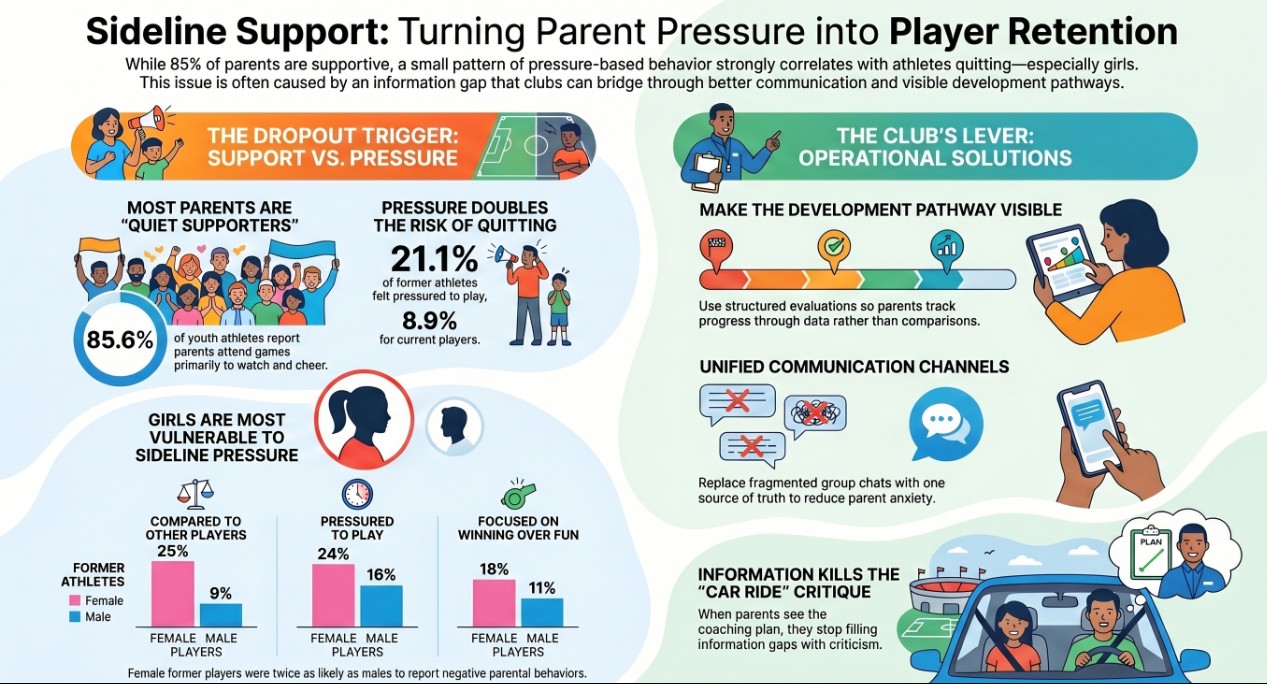
The Aspen Institute’s 2025 Youth Athlete Survey of 3,827 young athletes shows that the dominant mode of parent involvement in US youth sports is supportive (85% attend games, 84% encourage, 75% express pride regardless of performance). However, a smaller pressure-based pattern correlates strongly with dropout: 21.1% of former athletes said their parents pressured them to play when they did not want to, vs 8.9% of current athletes. The pattern hits girls hardest. Female former players were roughly twice as likely as male former players to report negative parental behaviors. The improvement opportunity is operational. Clubs that give parents structured visibility into player development behave differently because they have different information. The fix is not lecturing parents; it is giving them better tools.
Most parent involvement in US youth sports is positive. The Aspen Institute’s 2025 Youth Athlete Survey makes that point hard to argue with. 85.6% of current youth athletes say their parents come to games to watch and cheer. 84.8% say their parents encourage them to do their best. 79.8% say their parents make sure they have the equipment they need. 75.5% say their parents tell them they are proud of them, no matter how they perform.
That is the baseline. The vast majority of parents in US youth soccer are doing the things kids actually want them to do.
Before the conversation goes anywhere else, the industry needs to acknowledge what is going right. The narrative of the “youth sports parent” as a sideline-screaming villain is not what the data shows. The data shows the average parent is a quiet supporter who shows up and pays the registration fee.
But the same study contains a second pattern that is harder to read, and important to understand.
What the data shows is working
The good news is real and worth pausing on.
For current youth athletes, parent support is dense and consistent. 85.6% report parents at games. 84.8% report active encouragement. 75.5% report unconditional pride. 63.9% report parents helping them balance sport with school. 62.1% report parents practicing skills with them outside team practice.
This is not casual involvement. This is families investing time, money, attention, and belief into their kids’ sporting lives at scale. Across affluence levels, regions, and sports, the supportive baseline holds.
For directors of coaching, this is the foundation. Most parents at your club are on your side and want their child to thrive. The question is what to do about the smaller pattern that sits underneath.
Where the data turns
Compare current athletes to former athletes, and a different picture emerges.
Among former athletes, 21.1% said their parents pressured them to play when they did not want to. Among current athletes, the figure is 8.9%. That is more than double.
Among former athletes, 18.3% said their parents compared them to other players on the team. Among current athletes, 13.2% report the same. “Criticize my skills or abilities” runs 16.0% former vs 11.4% current. “Focus more on winning than having fun” runs 15.0% former vs 7.0% current. “Argue with the coach or referees” runs 10.3% former vs 3.5% current.
The pattern is consistent. Pressure-based parent behaviors are over-represented in the group that quit and under-represented in the group still playing.
The third group in the survey, kids who have never played organized sports, makes the picture sharper. They were asked which parent behaviors they would specifically not want to experience. 54.9% named comparing them to other players. 48.0% named pressure to play. 44.6% named focusing on winning over fun. 43.4% named being made to feel guilty or ashamed about performance.
Kids see this. They see it at games. They see it on the way home. And it factors into whether they decide to start at all.
The gender gap is real
The Project Play analysis of the Aspen findings went deeper into who is being driven out. Among former athletes, girls report meaningfully higher rates of pressure-based parent behaviors than boys.
Female former players were roughly twice as likely as their male counterparts to report parents comparing them to other players, pressuring them to play when they did not want to, and arguing with coaches or referees during games. The pattern holds across every category of negative parental behavior the study tracked.
| Negative parent behavior reported | Female former players | Male former players |
| Compared to other players | 25% | 9% |
| Pressured to play | 24% | 16% |
| Argued with coach or referees | 13% | 6% |
| Focused on winning over fun | 18% | 11% |
Source: Project Play / Aspen Institute analysis of the 2025 National Youth Athlete Survey.
Decades of research have shown that girls tend to be more sensitive to social evaluation and relational signals in sport contexts. The Aspen data confirms what coaches running girls’ programs already see on the sideline. Critical, comparison-based, or combative parenting drives girls out of the game faster than it drives boys out.
For directors of coaching running girls’ teams, this is operational. Parent communication aimed at girls’ programs needs to do specific work. Visible development frameworks, structured evaluation cycles, and clear coach communication matter more, not less, for the segment of your club that is the most sensitive to mixed signals from the sideline.
Why this is a club problem, not just a parent problem
Reading these numbers and concluding that the issue is bad parents is the easy answer. It is also wrong, or at least incomplete.
Parent behavior at youth sports is shaped by the information parents have. A parent who has no idea what their child is being coached on this season fills in the blanks themselves. They ask about the score on the way home, because the score is the only data point they can see. They compare their kid to the player who got more minutes, because playing time is the only metric the club has shared. They push for harder training, because the club has not made it clear what is already being trained.
A parent who can see the season’s coaching plan, who receives structured evaluations, who understands where their child sits on a real development pathway, behaves differently. Not because they are a fundamentally different parent, but because they have different information.
This is the club’s lever. Parent communication is not a parent problem you fix by sending more emails. It is a club product you build by running the operation differently.
How clubs can improve the experience
Three operational shifts move the curve.
Make the development pathway visible. Parents who see what their child is working on this season ask better questions. They stop comparing playing time, because they understand what the coach is actually evaluating. A coaching platform that supports structured player evaluations turns one-off conversations into ongoing visibility. The Aspen data suggests this is where the largest gains live.
Give parents one channel that actually works. Most clubs run parent communication across email, WhatsApp, group chats, the team manager’s spreadsheet, and a third-party scheduling app. The signal-to-noise ratio is poor. Parents fill information gaps with assumptions. A parent who cannot find game info in 30 seconds is a parent who calls the coach, then complains in the parking lot. A unified club management platform takes most of that friction out.
Set the tone from the top. The Aspen study found that “having a coach who cares about me” was a top-ten favorite for current athletes (13.4%) and ran even higher among kids who have never played (19.1%). Kids want a real adult relationship with their coach. When the operational load is handled by the system, coaches have time and headspace to actually be that adult, which models behavior parents pick up on.
The honest framing
The Aspen data is not telling us US youth sports parents are the problem. It is telling us that supportive parent involvement is the norm, but the minority pattern of pressure-based involvement correlates with kids leaving the game, hits girls harder than boys, and the kids who never started can already see the difference.
Clubs that take this seriously do not lecture parents. They build a club experience where the supportive version of parenting is easy and the pressure version has nowhere to go. The clubs winning that battle are the ones running real evaluations, real communication, and real transparency.
That is operational work. It is solvable. And as Aspen’s data shows, it is the work that determines whether a 12-year-old still wants to play the game next season.
What’s coming next in the series
This is the second post in a three-part series on what the 2025 Youth Athlete Survey means for youth soccer clubs and academies. The final post: cost, access, and the 13-year-old cliff in soccer.
Further reading
The Aspen Institute’s full 2025 Youth Athlete Survey is available through the Aspen Institute Sports & Society Program. For a topline summary of the 15 most significant findings, see Jon Solomon’s Project Play analysis.
FAQ
It shows that the dominant mode of parent involvement is supportive: 85.6% of current youth athletes say their parents come to games, 84.8% say their parents encourage them, and 75.5% say their parents express pride regardless of performance. Pressure-based behaviors are a minority pattern but correlate strongly with dropout.
Not the only reason. Bad coaching is the single most-cited complaint among current athletes (22.9%). But pressure-based parent behaviors (comparison, criticism, focus on winning) are significantly more common among former athletes than current ones, suggesting they are a meaningful contributing factor.
Yes. The Project Play analysis of the Aspen findings shows that female former players were roughly twice as likely as male former players to report being compared to other players (25% vs 9%), pressured to play (24% vs 16%), and to have parents arguing with coaches or referees (13% vs 6%). For directors of coaching running girls’ programs, this is a specific operational signal.
Move communication into a single channel built into the club management platform. Make the season’s coaching plan visible. Provide structured evaluations on a regular cycle. Give parents a clear view of their child’s development pathway, so they fill in fewer gaps with their own assumptions.
The Aspen study found that 54.9% named comparing them to other players, 48.0% named pressure to play, 44.6% named focusing on winning over fun, and 43.4% named being made to feel guilty or ashamed about performance.
EasyCoach is the connected platform clubs run on. Parent communication, evaluations, schedules, and payment workflows live in one place. Parents have a single source of truth, coaches have a structured way to share progress, and the director of coaching has the visibility to keep both sides aligned.
Run it like the pros.
The platform Villarreal CF runs on.
See EasyCoach on your club or your federation. Book a 20-minute demo with our team.

Modern Trends for Set-Piece Success
Modern Trends, Edge-of-the-Box Exploitation, and Effective Coaching Strategies
Marko Krnjić: 5 Key Insights for the Modern Football Coach
Lessons from a Career in Elite Performance

The Skill of Being Yourself: A Guide to Human-Centric Coaching
Practical Lessons on Mentorship, Practice Design, and Fostering Belonging